
TL;DR
Market research for financial services requires tools that handle trust-sensitive audiences, regulatory constraints, and privacy expectations that generic consumer research platforms often ignore. This guide compares nine tools across pricing, features, user sentiment, and financial services fit so your team can pick the right stack. Start with MixBright for fast, confidence-labeled audience intelligence and personas, then layer in survey platforms, syndicated data, market intelligence, or a research firm depending on what the decision demands.
Why Market Research for Financial Services Is Harder Than You Think
Financial services customers are not buying shoes. They are making decisions about money, debt, retirement, insurance, identity, and risk. That changes everything about how research needs to work.
The numbers make this concrete. The FDIC’s 2023 National Survey found that 5.6 million U.S. households were unbanked, 19.0 million were underbanked, and 49.7% of banked households used nonbank payment services like PayPal, Venmo, or Cash App source. Among unbanked households, “don’t trust banks” remains the second most cited reason for not having an account source. These are not edge cases. They represent real segments that basic demographic segmentation misses entirely.
Add regulatory pressure: the SEC’s marketing rule requires investment advisers to have a reasonable basis for material claims and restricts how testimonials and endorsements can be used source. The CFPB’s Personal Financial Data Rights Rule, finalized in October 2024, aims to build a competitive open banking system, but its compliance dates were stayed by the court in late 2025 and possible amendments are under discussion source. Research workflows built on assumptions about easy consumer-permissioned financial data access are standing on unstable ground.
All of this means the best market research tool for financial services is not the one with the biggest dashboard. It is the one that helps your team turn sensitive, fragmented, fast-changing signals into decisions you can defend.
This article compares nine tools and one service category by pricing, data type, financial services fit, user sentiment, and honest limitations. It also includes a decision framework so you can pick the right approach for your specific situation, whether that is a bank, credit union, fintech, insurer, wealth manager, or agency.
At-a-Glance Comparison Table
| Tool | Best For | Starting Price | Primary Data Type | Key Differentiator | Main Limitation |
|---|---|---|---|---|---|
| MixBright | Fast audience intelligence and presentation-ready personas | Demo available; pricing on request | Brand inputs, audience research, behavioral trends, AI synthesis | Confidence labels (First-Party, Data-Backed, AI-Inferred); deck-ready exports | No public pricing; limited third-party reviews |
| Qualtrics Strategic Research | Enterprise primary research | $420/mo (billed annually at $5,040) | Surveys, video/audio feedback | Advanced methods: conjoint, MaxDiff, concept testing, crosstabs | Expensive for small teams; complexity |
| SurveyMonkey | Budget-friendly surveys and quick feedback | $30/user/mo (Team Advantage, 3-user min) | Surveys and forms | Easy creation, templates, 200+ integrations | Advanced features gated behind higher tiers |
| GWI | Syndicated consumer segmentation | Free tier; Plus $150/user/mo | Global consumer survey data | Audience sizing, profiling, crosstabs, media preferences | Regional gaps; export limitations |
| AlphaSense | Financial market and competitive intelligence | Custom pricing (G2 perceived cost: $$$$$) | Filings, transcripts, broker research, expert calls | AI search across premium financial content | High cost; learning curve; information overload |
| Bloomberg Terminal | Institutional real-time market data | ~$31,980/year (industry estimate) | Real-time market data, analytics | Institutional standard for trading and research | Not for marketing personas; steep cost and learning curve |
| Brandwatch | Social listening and consumer conversation analysis | Quote/demo model | Social, web, forums | Sentiment analysis, conversation monitoring, segmentation | Pricing opacity; noisy data without query expertise |
| SparkToro | Audience channel and media discovery | Free tier; Personal $50/mo | Clickstream, social, search, podcasts | Shows where audiences spend attention quickly | Not primary research; weaker for pain validation |
| Tableau | Visualizing internal research and customer data | Viewer $15/user/mo | Internal structured data | Best-in-class dashboards and visual analytics | Does not collect research data; requires analyst skill |
How to Choose a Market Research Tool for Financial Services
Before comparing features, answer five questions.
What type of research do you actually need? There is a big difference between understanding who your audience is (personas, segmentation), collecting new data from them (surveys, interviews), monitoring what they say publicly (social listening), and tracking competitors and market movement (intelligence). Most financial services teams need some combination, but starting with the wrong tool wastes budget.
How sensitive is the data? Financial services audiences are unusually privacy-conscious. Qualtrics XM Institute’s 2025 research on over 23,000 global consumers found that people are least comfortable with companies using their financial information for personalization source. Any tool you choose should make it clear where insights come from and how data is handled. If you are evaluating platforms, understanding what to look for in a customer insights platform matters more in financial services than in most other verticals.
Do you need stakeholder-ready outputs or raw data? A product team exploring early-stage hypotheses has different needs than an agency pitching a bank on a campaign strategy. If the output needs to survive a boardroom, compliance review, or client presentation, format and evidence transparency matter.
Who will use the findings? Marketing, sales, product, compliance, and executive teams all interpret research differently. Tools that label insight confidence levels, such as separating verified facts from AI-generated hypotheses, reduce the friction of cross-functional alignment.
What is your budget and timeline? Primary research with statistically robust sample sizes takes weeks and thousands of dollars. A research firm specializing in financial services might charge significantly more depending on audience difficulty and methodology. Tools that synthesize existing inputs into usable personas can compress timelines from weeks to minutes, though they serve a different purpose.
Drive Research’s cost guide notes that market research pricing depends on target audience, method, incentive strategy, number of completes, incidence rate, interview length, and reporting needs. Lower incidence audiences cost more, and longer surveys increase dropout source.
The Evidence Confidence Ladder
One framework that is particularly useful for financial services teams: grade your insights by evidence strength before acting on them.
- First-party verified: Customer data, interviews, internal analytics, CRM records.
- Data-backed external: Government statistics (FDIC, CFPB, Census), syndicated survey panels, analyst research, regulatory filings.
- Observed public conversation: App reviews, Reddit threads, social listening, support forums.
- AI-inferred: Patterns or hypotheses generated by synthesizing inputs.
- Assumption: Internal belief without evidence.
This hierarchy maps directly to how financial services compliance teams think. The SEC marketing rule demands a reasonable basis for material claims. Research outputs that blur the line between verified data and AI guesswork create regulatory risk. Tools that separate these layers, like MixBright’s confidence labeling system (First-Party, Data-Backed, AI-Inferred), reduce that risk by design. For deeper context on building data-driven personas using evidence hierarchies like this, the approach matters even more in regulated industries.
1. MixBright
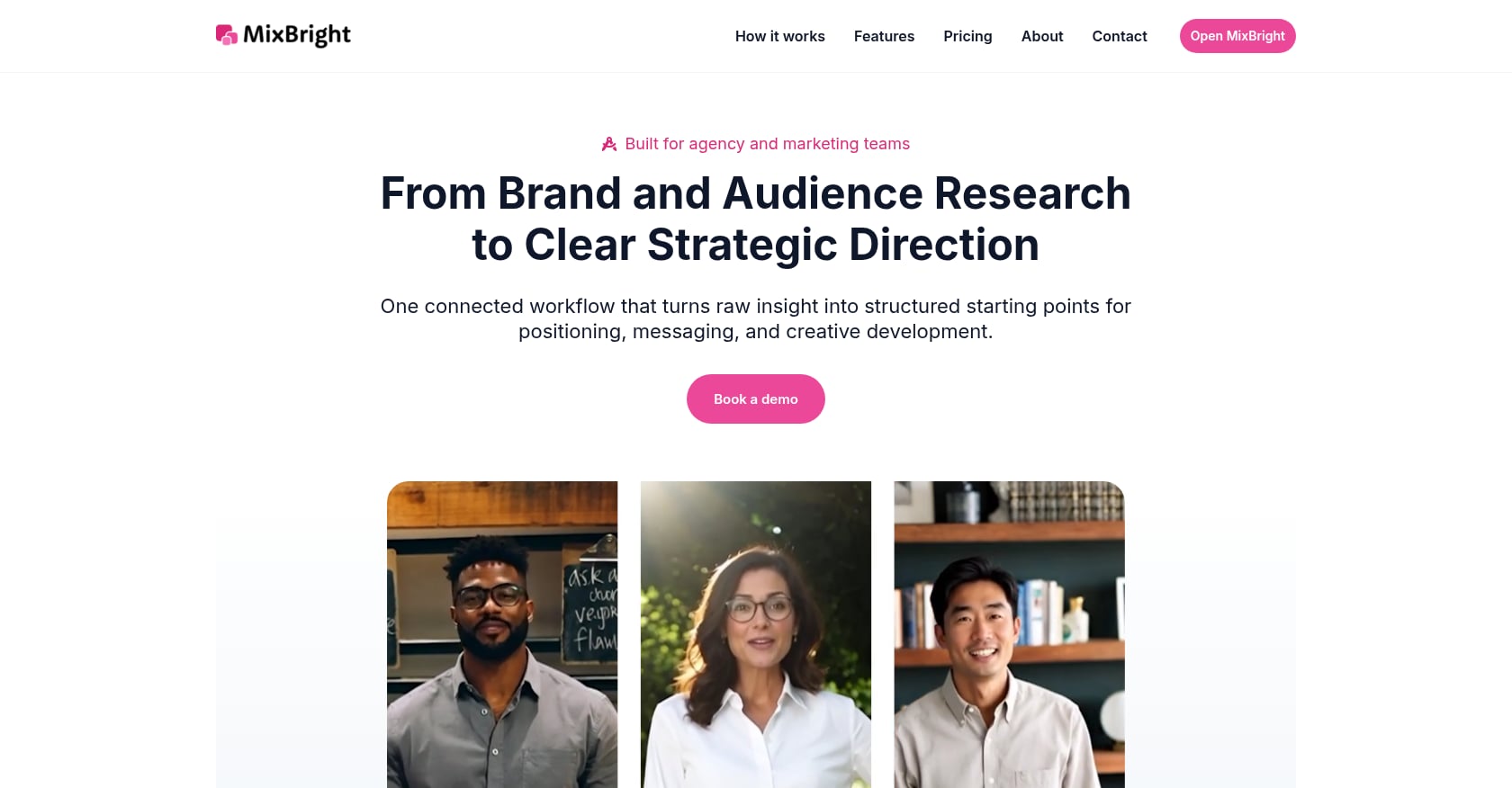
Best for: Fast, defensible audience intelligence and presentation-ready financial services personas.
MixBright turns a URL or brief into research-grade brand insights, a 360° audience overview, and polished personas in minutes. It is built for teams that need research outputs they can defend, not just dashboards they can screenshot.
Pricing:
- Public self-serve pricing is not currently published.
- Demo available via booking.
- The product is in Beta. Check the MixBright pricing page for current availability.
Key features:
- Guided workflow from brand inputs to audience insights to personas.
- Confidence labels on every insight: First-Party, Data-Backed, or AI-Inferred.
- Buyer, user, and marketing persona types tailored to different teams.
- One-click export to Google Slides, PowerPoint, and PDF.
- Photorealistic, royalty-free persona images.
- In-app editing and customization.
- Privacy and security posture aligned with GDPR, CCPA, and PIPEDA expectations.
- Documented methodology and research transparency.
Best financial services use cases:
- Building personas for a fintech product launch or banking campaign.
- Creating credit union member segments quickly.
- Preparing pitch decks for financial advisor, insurance, or wealth management clients.
- Aligning product, marketing, and sales around a single audience story.
- Generating AI-assisted personas from scattered inputs under tight deadlines.
Why it fits financial services:
Financial services teams cannot afford to present insights built on invisible assumptions. The confidence labeling system directly addresses the problem of AI-generated outputs being hard to trust. When a compliance officer or CMO asks “where did this come from?”, labeled insights provide an answer. The export-ready format also matters: financial services marketing teams often need artifacts that survive internal review chains, not just analyst workflows.
Limitations:
- No public pricing or plan tiers yet.
- No public free trial.
- Limited public integrations or API documentation.
- Third-party reviews and case studies are not yet publicly available.
- AI-generated persona images may need internal review before use in regulated external materials.
How to evaluate: Because public pricing and third-party review volume are not available, the best evaluation path is a demo with a methodology review and sample output assessment. Book a MixBright demo to see how confidence-labeled outputs work with your financial services inputs.
2. Qualtrics Strategic Research
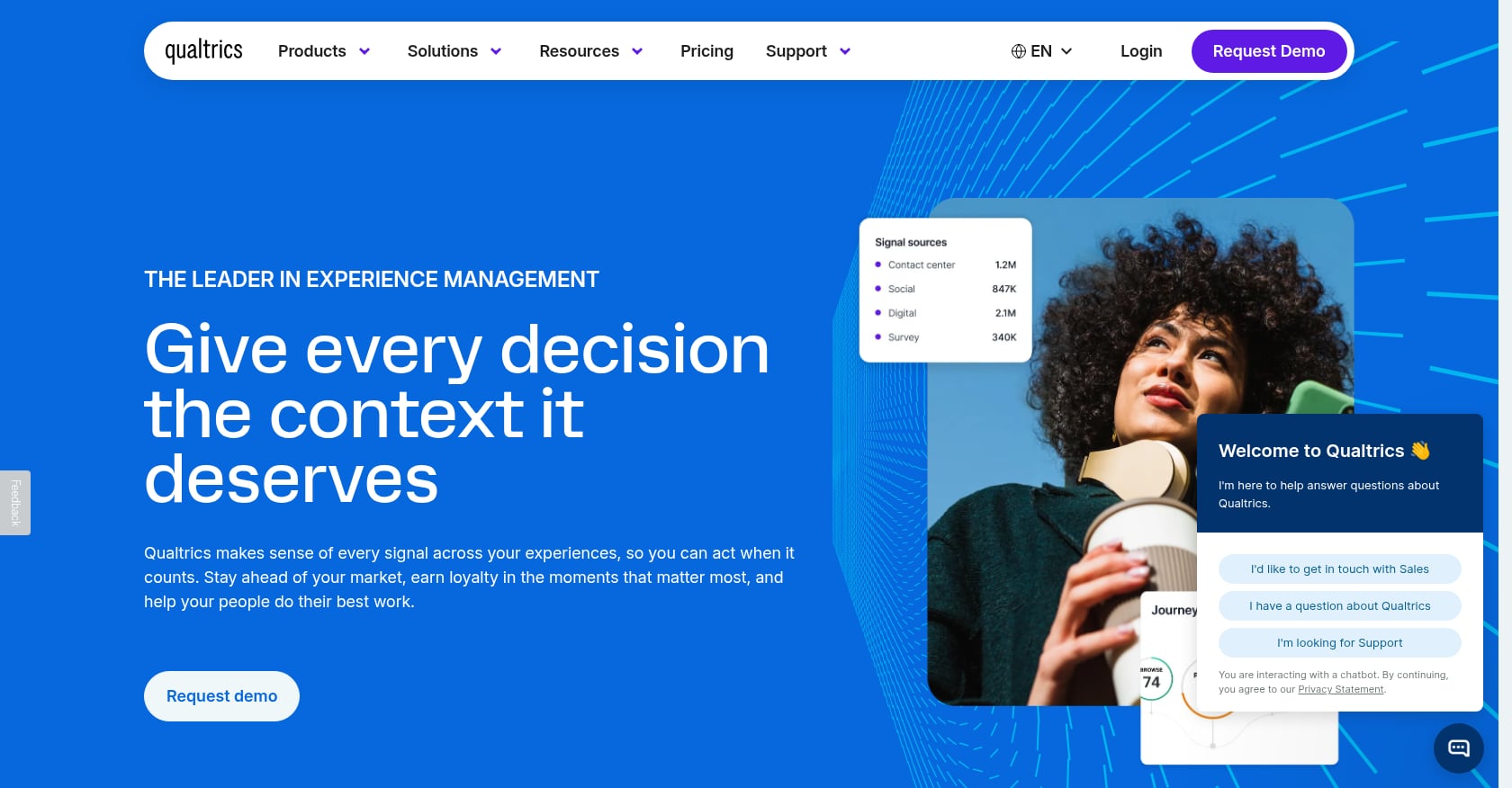
Best for: Enterprise-grade primary research with advanced methodology.
Qualtrics is the platform financial services teams reach for when they need statistically structured primary research: brand tracking, product concept testing, pricing studies, voice-of-customer programs, and satisfaction measurement.
Pricing:
- Small-business Strategic Research: $420/month, billed annually at $5,040 for 1,000 responses shared across all users source.
- Enterprise Strategic Research: quote-based, priced by interactions (survey responses, video feedback minutes).
- 30-day trial available; downgrades to free Qualtrics Surveys if not upgraded.
Key features:
- 23 question types, unlimited surveys and questions per survey.
- Guided solutions: conjoint, MaxDiff, concept testing, market landscape assessment, video diaries.
- Crosstabs, statistical analysis, and dashboards.
- Generative AI-powered video feedback summarization.
- Highlight reels for stakeholder presentations.
Best financial services use cases:
- Brand perception tracking for banks, insurers, or fintechs.
- Pricing research for deposit accounts, credit cards, loan products, or insurance bundles.
- Customer/member satisfaction and NPS programs.
- Product concept testing before launch.
- Enterprise-scale voice-of-customer programs.
What users say:
G2 reviewers praise Qualtrics for research breadth, brand research capabilities, and deliverable quality. One enterprise reviewer noted it helped surface B2B brand perceptions that were difficult to gather otherwise, though the research did not go deep enough in some niche growth areas source. Practitioners on Reddit have been harsher, with some complaining about rising pricing and inconsistent quality in full-service research engagements.
Limitations:
- Expensive for smaller teams and can be overkill for simple feedback needs.
- Enterprise setup requires research expertise.
- Synthesizing survey results into personas or strategy decks requires a separate step (or a tool like MixBright).
- Quality may vary by engagement type, based on user reports.
3. SurveyMonkey
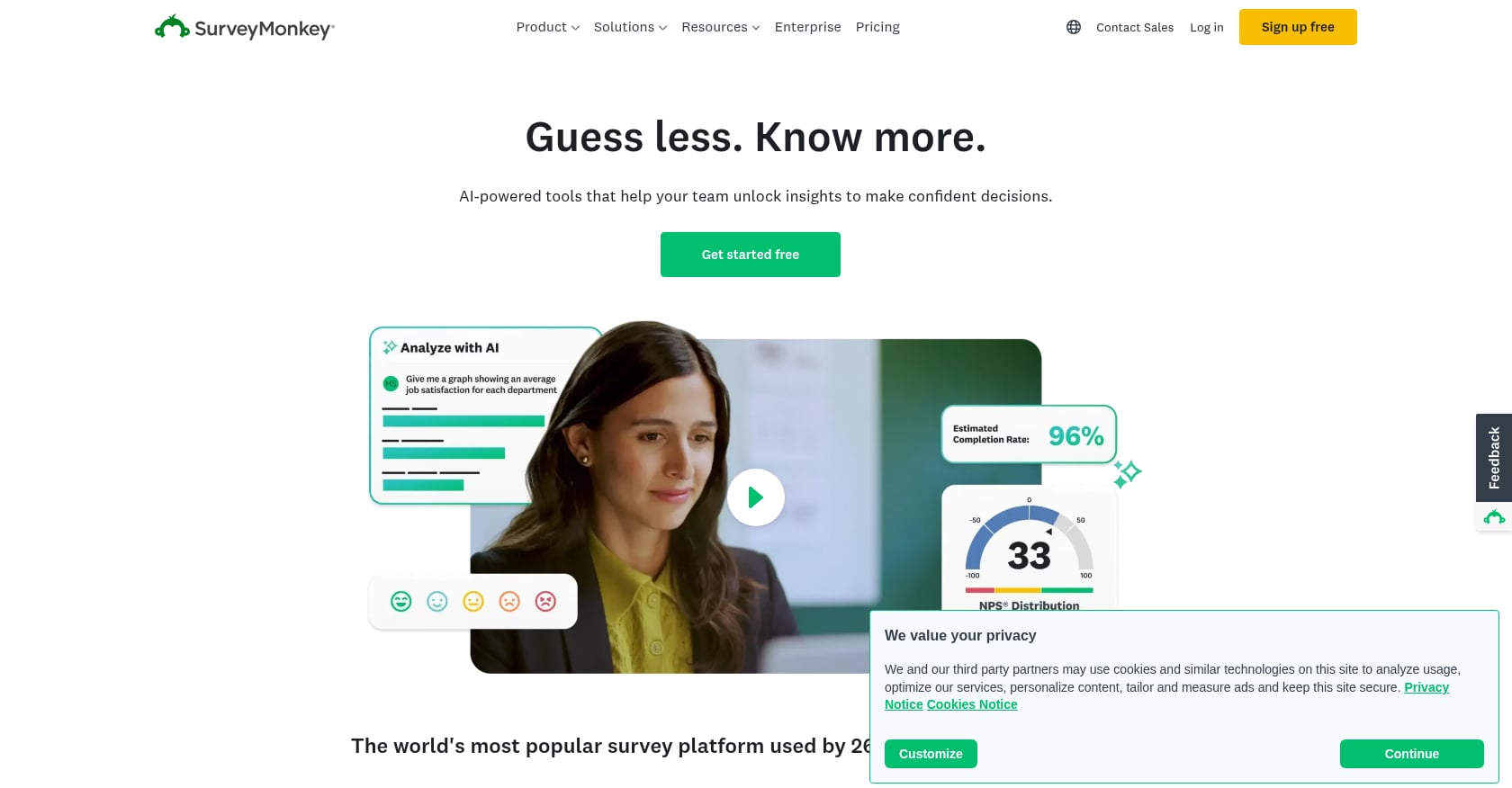
Best for: Lower-cost surveys and quick customer or member feedback.
SurveyMonkey is the default “just get a survey out” tool for teams that do not need enterprise research infrastructure.
Pricing:
- Team Advantage: $30/user/month (3-user minimum, billed annually), 50,000 responses/year source.
- Team Premier: $92/user/month (3-user minimum, billed annually), 100,000 responses/year.
- Enterprise: custom pricing.
- Additional responses: $0.15 each. SurveyMonkey Audience (recruited panel) sold separately.
Key features:
- Unlimited surveys, forms, and quizzes on paid plans.
- Market research methods: MaxDiff, TURF analysis, concept testing, price optimization.
- Skip logic, piping, custom branding, multi-survey analysis.
- 200+ integrations on team plans.
- Enterprise options include Salesforce, Tableau, and Power BI integrations.
Best financial services use cases:
- Quick member/customer pulse surveys for banks and credit unions.
- NPS and satisfaction tracking.
- Early concept validation for new account types or digital features.
- Internal stakeholder alignment surveys.
- Financial education content feedback.
What users say:
SurveyMonkey holds a 4.4/5 on G2 with over 23,000 reviews. Users praise ease of use and templates but consistently criticize advanced features being locked behind paid tiers source. Practitioners on Reddit’s UX research community report that pricing structures and feature gating get confusing quickly, especially when teams outgrow the basic plan.
Limitations:
- Free and lower tiers are restrictive enough to frustrate regular users.
- Not a persona generator or audience intelligence platform.
- Survey design for financial services requires care around compliance, question wording, and privacy, which the tool does not provide by itself.
- Panel (Audience) costs add up for hard-to-reach financial segments.
4. GWI
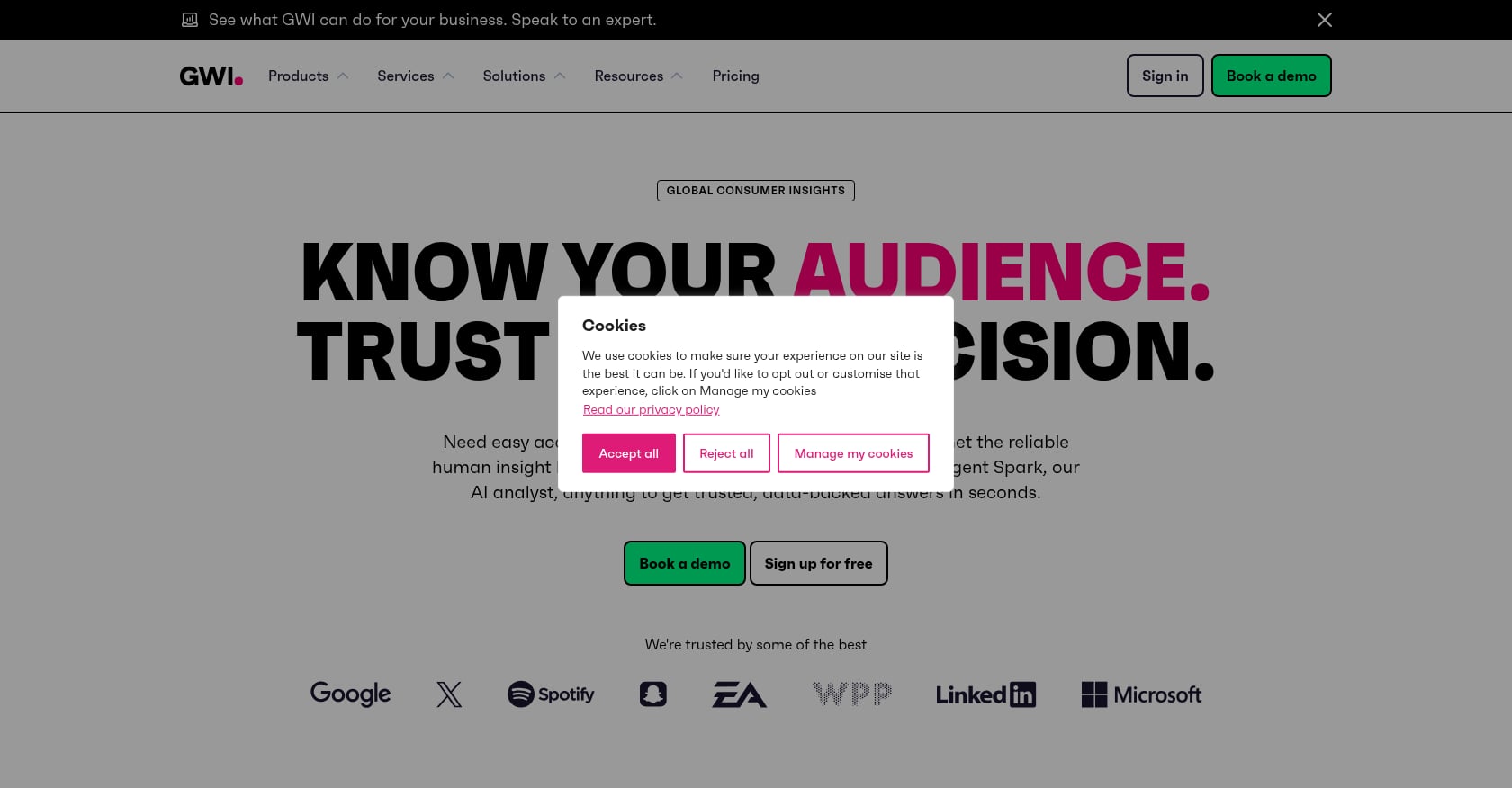
Best for: Syndicated consumer segmentation and audience sizing across markets.
GWI provides global consumer survey data that financial services teams can use to size audiences, compare behaviors by market, validate persona assumptions, and plan media.
Pricing:
- Free: 10 Agent Spark prompts/month, unlimited GWI Canvas decks, chart generation.
- Plus: $150/user monthly or $1,500/user annually. Unlimited prompts, chart exports, unlimited Canvas decks source.
- Teams and Pro: quote-based. Pro includes up to 250K profiling points.
Key features:
- Audience profiling and segmentation from ongoing consumer surveys.
- Agent Spark AI prompts for quick consumer questions.
- GWI Canvas for presentation-ready audience decks.
- Crosstabs, charts, dashboards, and historic data on higher plans.
Best financial services use cases:
- Sizing audience segments for banking, fintech, insurance, wealth, or payments campaigns.
- Media planning and channel preference analysis.
- Comparing consumer financial behaviors across markets.
- Validating persona assumptions with representative syndicated data.
- Building pitch-deck audience context for agencies.
Understanding the behavioral segmentation possibilities in financial services (switching triggers, mobile banking adoption, financial confidence levels) helps you get more out of GWI’s datasets.
What users say:
G2 reviewers praise GWI’s crosstabs, audience indexing, and fast profiling. Common complaints include messy crosstab exports, difficulty searching questions, Boolean complexity, regional and cultural data gaps, and AI-generated analysis that struggles with complex cross-country or year-over-year comparisons source.
Limitations:
- Syndicated survey data will not answer niche questions about your specific financial product.
- Deeper needs may require enterprise tiers or custom datasets.
- Export quality is inconsistent according to users.
- Not a replacement for primary research with your own customers.
5. AlphaSense
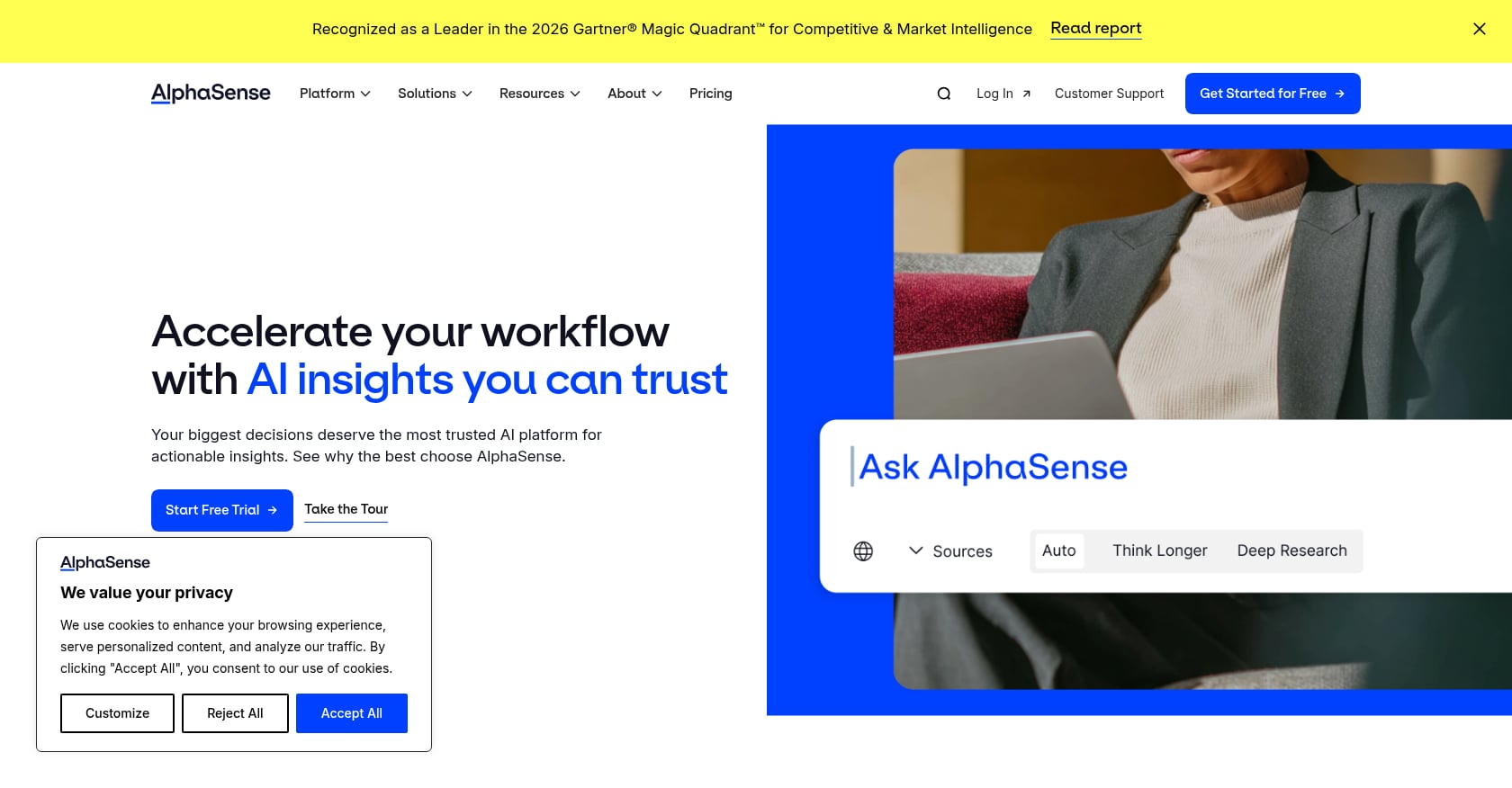
Best for: Premium financial market intelligence and competitive research.
AlphaSense is an AI-powered search platform for premium financial and business content: broker research, earnings transcripts, filings, expert calls, regulatory content, and news.
Pricing:
Key features:
- AI search across broker research, filings, expert transcripts, news, and trade journals.
- 4,500+ prebuilt financial models.
- Alerts, dashboards, collaboration, note-taking.
- Live transcript processing and spreadsheet table tools.
Best financial services use cases:
- Competitor monitoring for banks, fintechs, insurers, and asset managers.
- Investment research and market landscape analysis.
- Earnings-call and regulatory-filing synthesis.
- Due diligence for corporate strategy and product planning.
- Monitoring macroeconomic themes affecting financial products.
What users say:
G2 reviewers give AlphaSense 4.6/5 and praise time-saving research, AI summaries with citations, and premium content consolidation. Complaints focus on cost, learning curve, noisy alerts, and limited coverage for some regions or companies source. Reddit discussions mirror this split. Some users question whether the cost is justified when AI tools can summarize public filings for free. Others counter that AlphaSense is not comparable to ChatGPT because it includes proprietary content like expert transcripts and broker research that you cannot get elsewhere.
Limitations:
- Strong for market intelligence, weak for consumer persona generation.
- Premium cost is hard to justify for marketing teams that do not need financial data depth.
- Requires training and discipline to filter effectively.
- Does not produce polished personas or campaign decks.
The practical rule: do not buy a premium market intelligence platform just because it has AI. Buy it if the proprietary sources and workflows are worth the annual cost for your specific use case.
6. Bloomberg Terminal
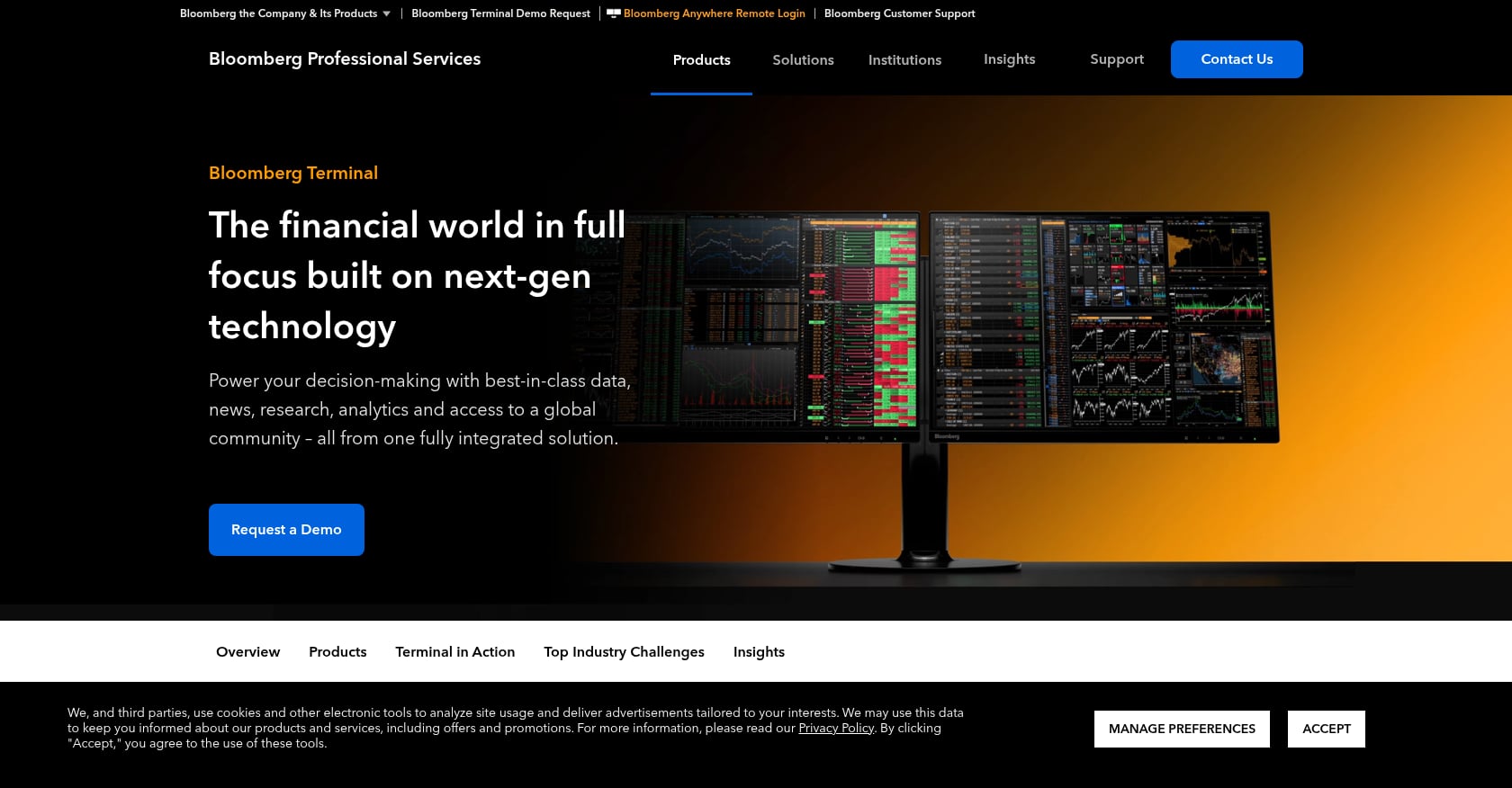
Best for: Institutional real-time market data, trading, and research workflows.
Bloomberg Terminal is the institutional standard for capital markets data. It appears in this list because financial services readers expect it, but it serves a fundamentally different purpose than marketing or audience research.
Pricing:
- Bloomberg does not publicly disclose pricing. Industry sources estimate approximately $31,980/year for a single terminal and $28,320/terminal/year for multiple terminals source.
Key features:
- Real-time data for stocks, bonds, commodities, currencies, and derivatives.
- Bloomberg News, equity research, SEC filings, earnings transcripts.
- Analytics, screening, charting, and financial modeling.
- Market execution and order management.
- Bloomberg messaging (a networking tool in itself).
Best financial services use cases:
- Trading desks and portfolio management.
- Asset management and institutional research.
- Fixed income, currencies, commodities, and derivatives analysis.
- Financial market monitoring workflows.
What users say:
Reddit discussions reveal why Bloomberg persists despite the cost: proprietary chat, aggregated market data that is difficult to replicate, and workflows that institutional teams rely on daily. Other users call the platform outdated and prohibitively expensive for non-institutional use.
Limitations:
- Not built for marketing personas, audience strategy, or consumer segmentation.
- Prohibitive cost for marketing, product, or agency teams.
- Steep learning curve.
- Overkill for any team that needs customer insights rather than capital markets data.
7. Brandwatch Consumer Intelligence
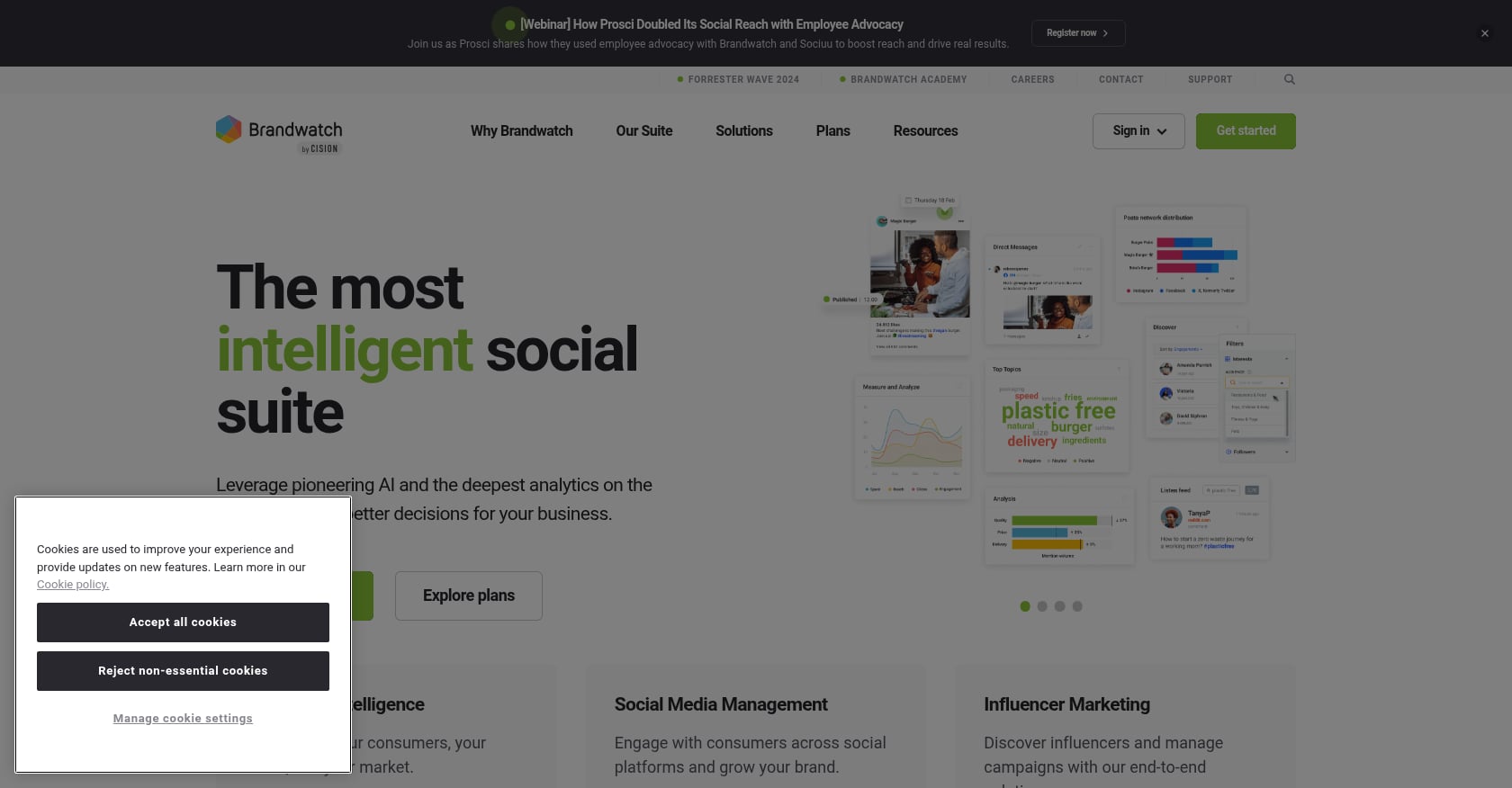
Best for: Social listening, sentiment tracking, and digital consumer conversation analysis.
Brandwatch monitors public conversations across social media, forums, review sites, and the web, turning unstructured text into sentiment trends, topic clusters, and audience segments.
Pricing:
- Quote/demo model with standard-to-enterprise plans. No published package prices source.
- G2 reports average implementation time around two months and ROI timeline around 12 months source.
Key features:
- Social listening across Facebook, Instagram, YouTube, X/Twitter, Reddit, and LinkedIn.
- Dashboards, segmentation, alerts, and reporting.
- Sentiment analysis at scale.
- Social media management and influencer marketing modules available.
Best financial services use cases:
- Monitoring consumer sentiment around a bank, insurer, card issuer, or fintech app.
- Tracking reputational risk and emerging service complaints.
- Competitive social listening.
- Understanding how consumers discuss fees, trust, fraud, digital banking, claims, or financial stress.
What users say:
G2 reviewers rate Brandwatch 4.4/5 and praise its ability to surface actionable insights from unstructured conversations. Common complaints include coverage gaps, learning curve, and platform limitations source. Reddit users looking for alternatives frequently cite enterprise pricing and onboarding burden as reasons to consider switching.
Limitations:
- Social data is not representative customer research. Vocal complainers are not a random sample.
- Requires query expertise to avoid noisy, misleading results.
- Financial services teams must be careful about how social-derived insights are presented in compliance-reviewed materials.
- Pricing opacity makes budgeting difficult.
8. SparkToro
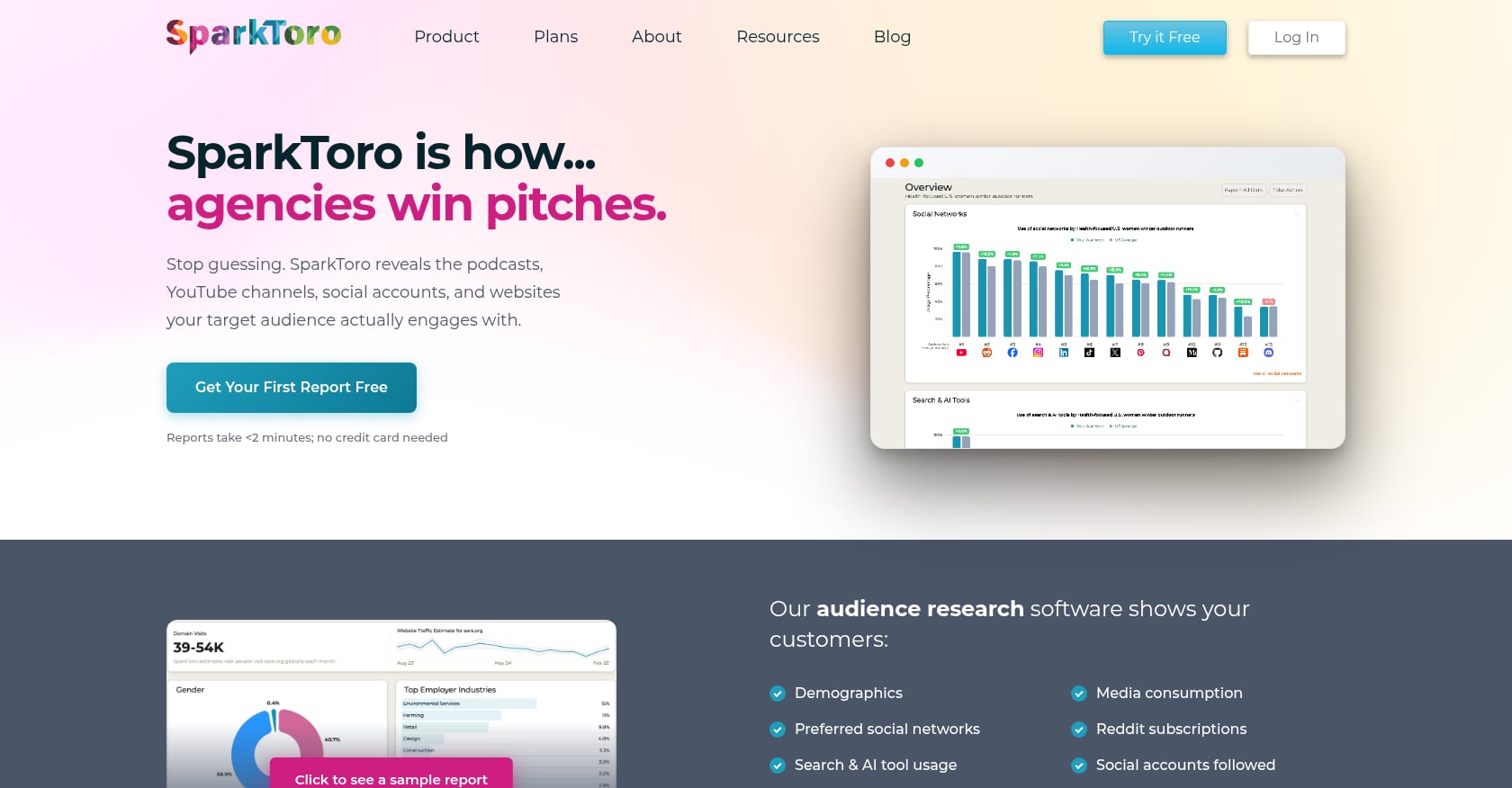
Best for: Finding where financial services audiences spend their attention online.
SparkToro answers the question “what does my audience read, watch, listen to, and follow?” using clickstream, search, and social data.
Pricing:
- Free: 5 reports/month.
- Personal: $50/month, 50 reports/month.
- Business: $150/month, 500 reports/month, up to 10 users.
- Agency: $300/month, unlimited reports, up to 100 users source.
Key features:
- Audience research by search keywords, social accounts, or websites visited.
- Shows websites, podcasts, YouTube channels, subreddits, and social accounts audiences engage with.
- Demographics, job roles, education, skills, and interests on higher plans.
- Lists and exports for outreach and media planning.
Best financial services use cases:
- Finding podcasts, YouTube channels, subreddits, and publications followed by banking, fintech, or wealth management audiences.
- Media planning for financial advisors, credit unions, or B2B financial services.
- Pitch research for agencies.
- Content partnership and influencer discovery.
- Early channel strategy before campaign launch.
What users say:
G2 reviewers praise SparkToro’s intuitive interface and speed for U.S.-based audience research, noting some limitations for non-English regions source. One Reddit user shared a telling critique: after spending money on SparkToro, they found the tool showed clean audience and media data but did not validate the actual product idea. Manual Reddit and Quora digging surfaced richer complaint language and pain points that the tool missed.
Limitations:
- Not a survey platform, financial data platform, or primary research tool.
- Shows attention patterns, not purchase barriers or willingness to switch providers.
- Global and non-English research may be weaker.
- Best paired with actual customer research and persona synthesis for strategic decisions.
9. Tableau
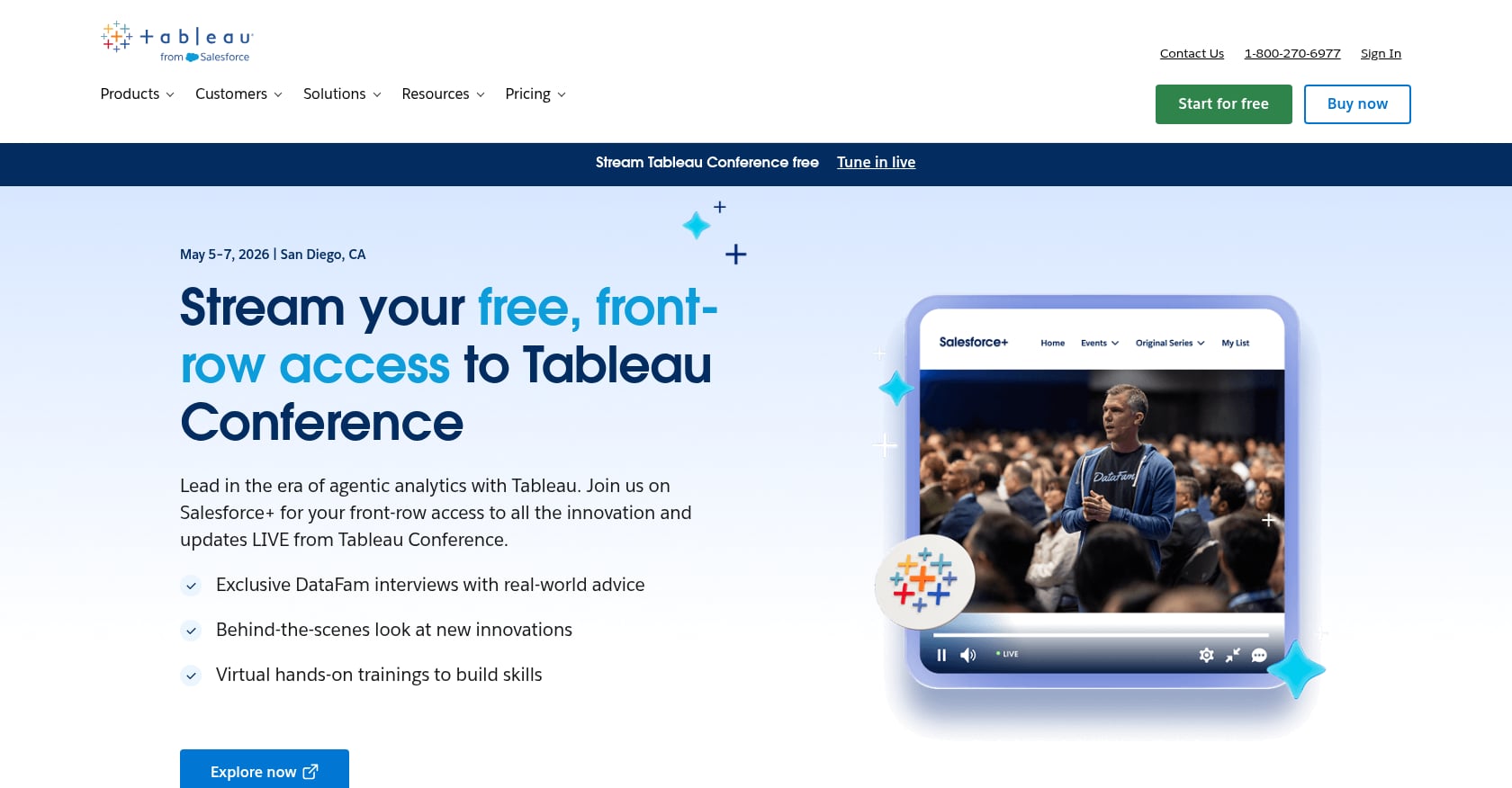
Best for: Visualizing internal research data and customer analytics for stakeholders.
Tableau does not collect market research. It makes existing data visible. For financial services teams that already have survey results, CRM exports, app analytics, or branch data, Tableau turns those into explorable dashboards.
Pricing:
- Standard: Viewer $15/user/month, Explorer $42/user/month, Creator $75/user/month (billed annually).
- Enterprise: Viewer $35, Explorer $70, Creator $115/user/month (billed annually) source.
- Every deployment requires at least one Creator license.
- Free Tableau Desktop edition available for local analysis with sharing limitations.
Key features:
- Drag-and-drop dashboards and visual analytics.
- Tableau Cloud, Server, and Next deployment options.
- Tableau Prep Builder for data preparation.
- Viewer, Explorer, and Creator roles for governance.
- Enterprise data management, AI features, and Slack integration on higher tiers.
Best financial services use cases:
- Visualizing member/customer research results.
- Combining survey data with CRM, branch, app, or product data.
- Executive dashboards for CX, retention, acquisition, or segmentation.
- Tracking campaign, branch, digital banking, or advisor funnel metrics.
What users say:
G2 reviewers praise Tableau’s visualization quality and integration breadth but frequently mention high licensing costs, steep learning curves for complex dashboards, and slow performance on large datasets source. Reddit discussions consistently focus on Creator license pricing and enterprise costs as pain points.
Limitations:
- Does not collect or generate market research data.
- Not built for persona creation.
- Requires data preparation and analyst skill.
- Costs scale quickly with team size.
- Dashboards still require strategic interpretation to become actionable.
When to Hire a Financial Services Market Research Firm
Sometimes no tool is enough. Hire a research firm when you need:
- Statistically defensible custom study design.
- Recruiting for hard-to-reach financial audiences (high-net-worth investors, small-business treasury managers, underbanked populations).
- Moderated interviews or focus groups with compliance-sensitive question design.
- Member or customer churn research with methodology documentation.
- Findings that must withstand board-level or regulatory scrutiny.
Firms like Drive Research offer financial services research including customer surveys, new account opening surveys, competitive rate analysis, closed account surveys, and focus groups. Their credit union case study involved 215 completed online surveys and 16 one-on-one qualitative interviews source. Escalent positions deep expertise across banking, wealth management, insurance, fintech, payments, lending, fraud, and retirement source.
Research firms and tools are not competitors. They are complementary layers. Use MixBright or GWI for fast audience hypotheses and persona foundations. Use a research firm when you need custom recruiting, moderated depth, and statistical rigor that no platform can automate.
Financial Services Research Considerations Most Tools Ignore
Trust Is a Segmentation Variable, Not Just a Brand Metric
In financial services, trust level predicts willingness to switch banks, share data, adopt fintech apps, use robo-advice, consolidate assets, and accept personalized offers. The FDIC found that distrust of banks is one of the top reasons households remain unbanked source. A good financial services persona should include trust posture alongside demographics and behaviors.
When building personas, psychographic segmentation captures these dimensions (risk tolerance, financial confidence, privacy sensitivity) in ways that demographic segmentation alone cannot.
Mobile-First Does Not Mean Digital-Only
The FDIC found 48.3% of banked households used mobile banking as their primary access method source. That leaves more than half who do not. Financial services personas should include channel preference and confidence with self-service, not just “uses mobile banking.”
Underbanked Users Are Not a Niche
19.0 million U.S. households are underbanked. They may have a bank account but still rely on nonbank services for core financial needs. Market research for financial services should not flatten “banked” and “financially secure” into the same persona.
Marketing Claims Need Substantiation
The SEC marketing rule prohibits misleading advertisements and requires a reasonable basis for material statements of fact source. This is not theoretical. It means research outputs used in adviser marketing, client presentations, or promotional materials should clearly separate verified facts from inferred patterns. Tools that mix these without labels create compliance exposure.
Recommended Stacks by Team Type
For Agencies
MixBright for persona generation and pitch deck outputs, GWI for audience sizing and validation, SparkToro for channel discovery, Brandwatch for social intelligence when the client needs reputation monitoring. Add SurveyMonkey or Qualtrics when primary survey data is required. Agencies working on B2B financial services pitches will especially benefit from confidence-labeled outputs that clients can trust.
For Banks and Credit Unions
MixBright for audience strategy and member persona foundations, SurveyMonkey or Qualtrics for member satisfaction and feedback programs, Tableau for internal data dashboards. Hire a research firm for major member studies requiring statistical rigor. Use FDIC data for contextual benchmarks.
For Fintechs
MixBright for product-market persona development, GWI for consumer behavior benchmarks, SparkToro for finding where early adopters spend attention, Brandwatch for social monitoring. Add Qualtrics for concept or pricing research. Be cautious about building workflows around assumed open banking data access, given the CFPB compliance timeline uncertainty source.
For Wealth, Asset Management, and Advisory Firms
MixBright for client persona alignment, AlphaSense for competitive and market intelligence. Add Bloomberg if institutional market data is central to the workflow. Build compliance review into any research-to-marketing pipeline because SEC marketing rules apply directly.
For Product and UX Teams
MixBright for fast audience alignment across teams, Qualtrics or SurveyMonkey for user feedback, Tableau for experience analytics. Add user interviews or a research firm for high-stakes UX decisions. Financial services product teams benefit from keeping personas current as regulations, rates, and user expectations shift rapidly.
The Practitioner’s Rule: Combine Formal and “Messy” Research
One pattern shows up consistently across Reddit and review communities. Practitioners who rely only on polished tool outputs miss real customer language. One Reddit user recommends tracking 3-star G2 and Capterra reviews, support tickets, and lost-deal notes, tagging for themes like pricing shock, complexity, missing features, and migration pain. Another found that manual Reddit and Quora research surfaced more actionable complaint language than a paid audience discovery tool.
For financial services teams, this means formal research tools should be layered with “messy truth” sources: app store reviews, call-center transcripts, advisor notes, branch feedback, Reddit threads, and consumer complaint databases. The best financial services market research workflow synthesizes both.
Final Recommendation
If your team needs raw financial market data, use Bloomberg or AlphaSense. If you need statistically robust primary research, use Qualtrics or hire a research firm. If you need syndicated consumer benchmarks, use GWI.
But if the core problem is turning scattered, sensitive, fast-changing audience signals into a clear, defensible strategy that marketing, product, sales, and compliance can align around, start with MixBright. Its confidence-labeled outputs, presentation-ready exports, and guided workflow from brand inputs to personas solve the problem that most financial services teams actually have: not more data, but usable, trustworthy synthesis.
Need research-backed financial services personas without waiting weeks? Book a MixBright demo to see how confidence-labeled audience insights and deck-ready personas can support your next campaign, pitch, or product strategy.
FAQ
What makes market research for financial services different from other industries?
Financial services audiences are making decisions about money, debt, retirement, insurance, and personal security. These topics carry high emotional stakes and privacy sensitivity. Research tools and methods must account for regulatory requirements (SEC, CFPB, FINRA), consumer distrust of financial institutions, and the need for substantiated claims in marketing materials. Generic consumer research tools often lack these guardrails.
How much does financial services market research cost?
Costs vary widely. Self-serve survey tools start at $30 to $420 per month. Syndicated consumer data platforms range from free tiers to custom enterprise pricing. Premium market intelligence platforms like AlphaSense and Bloomberg can cost tens of thousands per year. Custom research firms price by audience difficulty, methodology, sample size, and reporting needs, with lower-incidence financial audiences costing more to recruit.
Can AI tools replace traditional financial services market research?
AI tools can dramatically accelerate persona creation, audience synthesis, and pattern detection. They cannot replace primary research for statistical validation, moderated customer interviews, or compliance-sensitive study design. The best approach treats AI synthesis (like MixBright’s confidence-labeled output) as a fast foundation layer, then adds primary research and specialist data where the decision requires it.
What types of personas matter most in financial services?
Financial services personas should go beyond basic demographics. Useful persona dimensions include trust level, financial confidence, channel preference (mobile vs. branch vs. hybrid), product complexity tolerance, risk sensitivity, and life-stage financial goals. The FDIC data showing 19 million underbanked households and significant nonbank payment adoption illustrates why simplistic “banked customer” personas miss critical segments.
Should financial services teams use social listening for market research?
Social listening (through tools like Brandwatch) is valuable for tracking reputation, emerging complaints, and competitive sentiment. It is not representative primary research. Social data overrepresents vocal users and underrepresents the silent majority. Financial services teams should use social insights as one input layer, not as the basis for strategic decisions.
How do I choose between a research tool and a research firm?
Use tools when you need speed, ongoing monitoring, audience sizing, or synthesis of existing inputs. Hire a research firm when you need custom recruiting for hard-to-reach financial audiences, statistically robust methodology documentation, moderated qualitative research, or findings that must withstand board-level or regulatory review. Many teams use both.
What compliance considerations affect financial services market research?
The SEC marketing rule requires investment advisers to substantiate material claims and restricts testimonials and endorsements. The CFPB’s open banking rules add privacy constraints on consumer financial data use, though compliance timelines remain in flux. Research outputs used in regulated marketing should clearly separate verified facts from inferences. Tools with confidence labeling help maintain that separation.
How often should financial services personas be updated?
Financial services markets shift faster than most: interest rates change, regulations evolve, new competitors launch, and consumer channel preferences move. Personas should be reviewed quarterly at minimum and refreshed whenever a significant market event, product launch, or regulatory change occurs. Static personas built once and never revisited become liabilities rather than assets.