

Modern teams need answers in days, not months. Market research software turns scattered inputs and raw signals into decisions that move roadmaps, campaigns, and revenue. Privacy rules are stricter, cookies are fading, and budgets are watched closely, so the right stack must be fast, credible, and presentation ready. If you want a quick way to turn a URL or a brief into brand insights and personas, explore MixBright or see our AI persona generator guide.
What is market research software? Scope and types
Market research software is a set of applications that help teams discover customer needs, test ideas, and guide go to market decisions. The best tools combine data collection, analysis, and storytelling so you can defend your strategy with confidence.
Common categories and what they do
Survey and form platforms collect structured responses at scale
Qualitative research tools support interviews, focus groups, and diary studies
Audience intelligence platforms map who people are, what they do, and where they hang out online
Social and review listening tools capture conversation trends and sentiment
Experimentation tools run A B tests and lift studies
Panel and sample providers recruit respondents with defined attributes
Text and image analytics find themes, topics, and sentiment in unstructured data
Data visualization and dashboard suites help teams interpret and share results
Persona and storytelling tools turn findings into human centered narratives
Useful facts to ground scope
Qualitative research methods include interviews, moderated groups, and diary studies
Quantitative research methods include surveys, experiments, and descriptive studies
Conjoint analysis estimates the value of product attributes to predict preference
MaxDiff prioritizes options by forcing trade off choices
Card sorting informs information architecture and navigation
Cluster analysis groups audiences by shared attributes for segmentation
Where MixBright fits
MixBright converts a URL or brief into a structured brand summary, audience insights, and presentation ready personas
Every insight carries a confidence label, First Party, Data Backed, or AI Inferred, so stakeholders see provenance
Exports go straight into Google Slides, PPT, or PDF for fast client ready deliverables
Photorealistic, royalty free persona images increase engagement in workshops
Learn more or book a short demo at MixBright.
Where software fits across research methods and workflows
Market research software should support the full loop from discovery to activation.
Discovery and alignment
Create a single source of truth that captures positioning, features, and customer language. Tools for brand insight extraction and social listening shine here.Opportunity sizing
Use survey platforms, audience intelligence, and panel providers to validate total addressable audience and willingness to pay.Segmentation and personas
Combine behavioral data with qualitative signals to produce defensible segments and narratives, see our behavioral segmentation guide for examples. Persona tools translate analysis into stories sales and product can use.Proposition and creative testing
Run concept, message, and creative tests with statistically sound samples. Experimentation platforms and survey tools do the heavy lifting.Go to market planning
Map segments to channels and content. Audience intelligence and planning tools help define privacy safe and contextual tactics.Ongoing optimization
Keep a research inbox running. Feed new learnings into the same repository so the next sprint starts smarter.
A practical note
Market research software works best when it becomes the home for insights, not just a point in time project tool.
How to conduct market analysis with software: a six stage process
1) Define objectives, audiences, and constraints
State the decision to be made, the audience, the budget, and the time window
Write the hypotheses you want to confirm or reject
Fact 7) First party data is information collected directly from your audience
2) Consolidate first party inputs
Pull website copy, sales notes, CRM fields, previous surveys, and customer support themes into one place, use this customer insights playbook to decide what to collect and how to apply it
Summarize features, benefits, and positioning so the team shares the same starting point
Fact 8) Text analytics can extract topics and sentiment from open ended responses
Tip
Paste a brand URL or brief into MixBright to generate a structured brand insights summary with provenance labels.
3) Discover audiences and segment
Use audience intelligence and social listening to see who engages with your space and what they talk about
Run cluster analysis to group by needs, behaviors, or value
Fact 9) Cluster analysis is a standard method to form data driven segments
4) Design instruments and recruit
Choose surveys for quant questions and interviews for depth
Use MaxDiff or conjoint when you need trade off clarity
Select a panel or recruit from your list to match your target profile
Fact 10) MaxDiff is widely used to prioritize features or messages
5) Collect, analyze, and validate
Field the study, run quality checks, then analyze with appropriate statistics
Review qualitative clips and quotes to humanize the findings
Label each insight by evidence strength to reduce debate later
Fact 11) Confidence labeling, First Party, Data Backed, AI Inferred, improves transparency for stakeholders
6) Activate with stories and decks
Translate findings into buyer, user, or marketing personas that sales, product, and media can act on; if you’re unsure about the distinction, see marketing personas vs. buyer personas.
Export to polished slides with images and examples to drive adoption
Map segments to privacy safe activation and contextual targeting
Fact 12) Presentation ready exports to Google Slides or PowerPoint accelerate adoption across teams
For faster steps two through six you can generate presentation ready personas in minutes with MixBright.
Buying criteria and evaluation checklist
Choosing market research software is easier when you score tools against what matters most to your workflow.
Core criteria to compare
Data coverage and methods, what sources, what sample options, what analytics
Evidence transparency, can you see inputs, methods, and confidence for each claim? Review our methodology and data integrity approach for what good looks like.
Speed to usable output, minutes or weeks to get a presentation ready artifact
Export quality, one click Slides, PPT, or PDF and editable templates
Collaboration, versioning, comments, and permissions for cross functional teams
Privacy and compliance, alignment with GDPR, CCPA, and PIPEDA, encryption at rest
Security posture, enterprise grade hosting and clear data retention controls
Total cost of ownership, licenses, panels, services, and training
Vendor credibility, methodology documentation and track record
Quick scoring table
Criterion | Why it matters | What great looks like |
|---|---|---|
Evidence transparency | Reduces stakeholder friction | Confidence labels and clear sources for each insight |
Speed to deck | Beats deadlines without sloppy work | Minutes to Google Slides with brand ready formatting |
Segmentation power | Better targeting and messaging | Built in clustering and audience modeling |
Privacy alignment | Avoids risk and rework | GDPR CCPA PIPEDA aligned controls and audit trail |
Collaboration | Better decisions are shared decisions | Multiuser editing, comments, and permissions |
Facts to anchor buying choices
13) GDPR governs personal data processing for residents of the European Union
14) CCPA gives California consumers rights to access and delete personal data
15) Many teams prefer encryption at rest and enterprise grade hosting for research data
If you need transparent evidence labels and deck ready personas, consider a demo with MixBright.
Top 20 Market Research Software Tools
Building on the strategy and methods above, the tools below map the research workflow end to end. We’ve grouped them by the problems they solve, so you can scan by need, not vendor, and quickly shortlist options that fit your tempo and budget. Treat this as a practical field guide, not a ranking.
Survey & Experience Platforms
These platforms power structured feedback (such as surveys, CX/EX programs, and voice-of-customer) across email, web, mobile, and in-product channels. They’re grouped because they combine questionnaire design, sampling, distribution, and analytics in one environment, enabling both tracking studies and ad-hoc research at scale. Ideal for CSAT/NPS, concept tests, and ongoing experience measurement.
1. MixBright
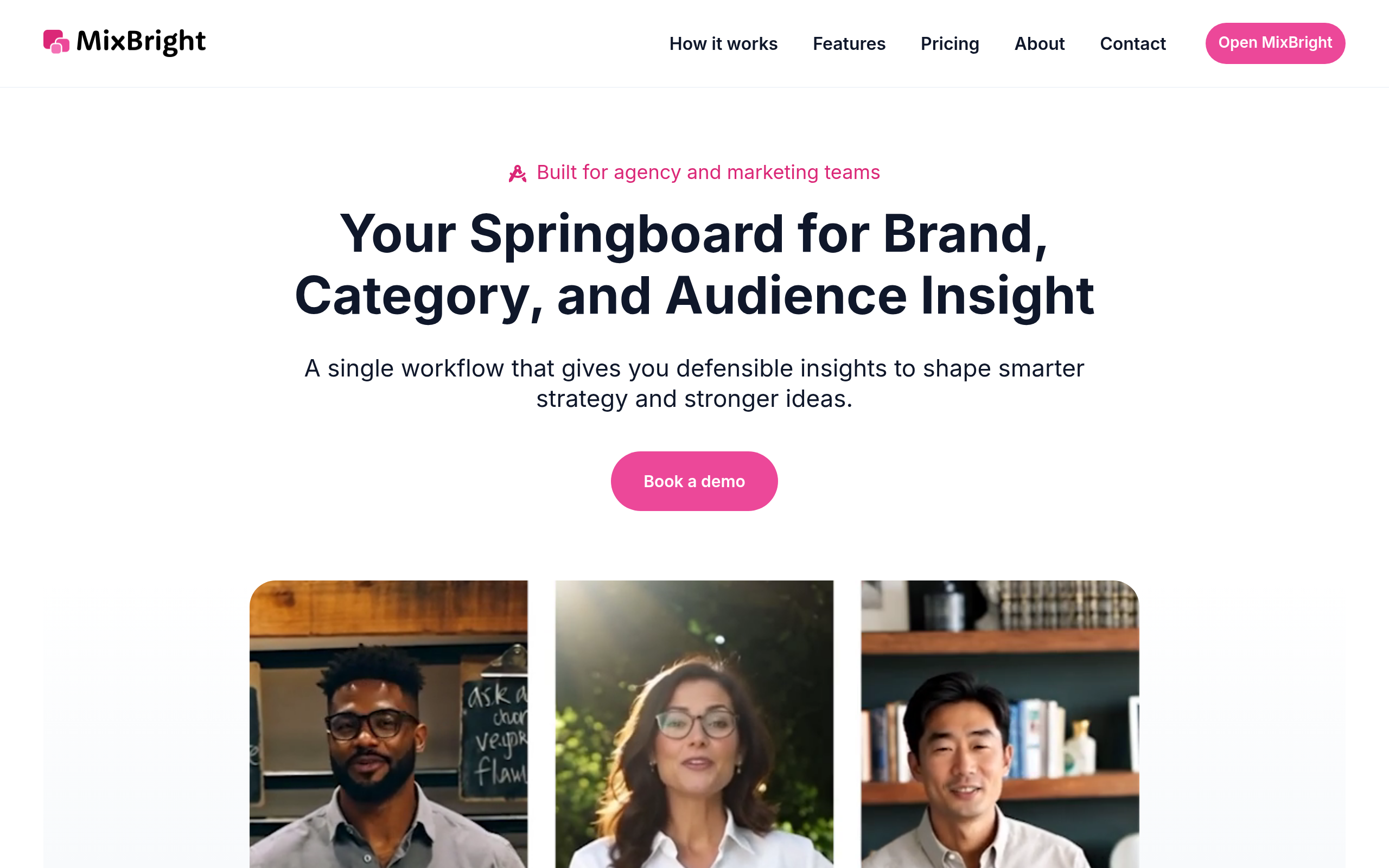
MixBright is built for teams who need research‑backed personas and pitch‑ready insight decks without weeks of fieldwork. It blends your brand inputs with sourced external evidence and clearly flagged AI explorations so every claim shows its work.
Data sources & trust: First‑party materials, curated third‑party research with captured citations, and AI‑inferred fills labeled by confidence, underpinned by a published methodology, visible confidence badges, and GDPR/CCPA/CPRA/PIPEDA/CASL‑aligned privacy (no training on your content).
Capabilities that move the needle:
Distill brand and market inputs into a single, sourced narrative of benefits, positioning, and purchase triggers.
Enrich insights with up‑to‑date industry reports and benchmarks; every claim carries a URL and recency stamp.
Generate buyer, user, and marketing personas with motivations, pains, triggers, and media habits, each attribute labeled by origin and confidence.
Export polished, presentation‑ready slides for pitches, creative briefs, and stakeholder readouts.
Edit any field while preserving confidence badges so teams can separate verified facts from exploratory hypotheses.
Who it’s for & where it shines: Agencies/consultancies, in‑house strategists and marketers, product/UX teams, and founders who need trustworthy audience intelligence fast. It excels at persona creation stakeholders will approve, GTM and creative brief development, pitch‑ready decks that speed alignment, and rapid discovery when budgets or timelines preclude new fieldwork.
Pricing snapshot: Currently in beta (December 8, 2025); pricing and GA timing aren’t public, request a demo, with plans shared upon launch.
2. Qualtrics

Qualtrics is the enterprise workhorse for end‑to‑end market, brand, product, and CX research, spanning study design, fielding, analysis, and governance. It unifies survey responses, panel data, first‑party profiles, and omnichannel text into one defensible source of truth.
Data sources & trust: Email/SMS, Slack/Teams, web and app intercepts, panels, and XM Directory first‑party data, augmented by Text iQ/XM Discover and Qualtrics AI. Fraud/bot checks, GDPR tooling, ISO/SOC 2/HITRUST/FedRAMP certifications. qualtrics.com
Capabilities that move the needle:
Build dynamic segments in XM Directory with AI‑suggested cohorts to guide sampling.
Design complex studies with randomization, branching, quotas, Conjoint, and MaxDiff.
Distribute via email/SMS, collaboration apps, web/in‑app intercepts, and an offline app for fieldwork.
Mine text with Text iQ and XM Discover to surface sentiment, themes, intent, and drivers.
Deliver dashboards and export PPTX, PDF, Word, CSV/XLSX; govern sharing with roles and SSO.
Connect Salesforce, Tableau, Slack, Zendesk, and REST APIs; enforce granular permissions and GDPR erasure.
Who it’s for & where it shines: In‑house research, agencies/consultancies, and product/UX and brand teams that need enterprise‑grade rigor with speed. Use it for pricing/packaging with Conjoint, concept/ad screening with MaxDiff, digital CX intercepts with real‑time routing, and unified VoC that turns into roadmap‑shaping, quant‑backed recommendations.
Pricing snapshot: Free tier available; Strategic Research starts at $420/month annually with 1,000 responses, advanced analytics, offline, panels, and capacity are add‑ons.
3. SurveyMonkey

SurveyMonkey is the familiar, flexible survey platform that scales from quick pulse checks to robust market studies. It’s fast to deploy, easy to govern, and widely understood by stakeholders.
Data sources & trust: First‑party surveys via links, email, web/app intercepts, kiosks/offline, mobile SDK, Enterprise SMS; targeted sample from SurveyMonkey Audience’s global panel. Quality controls, published methodology, SOC 2/ISO 27001, GDPR/CCPA, HIPAA BAA, and data‑residency options. See help.surveymonkey.com.
Capabilities that move the needle:
Draft surveys with AI, import from Docs/Word, and enforce brand standards; admins govern AI access.
Recruit 335M+ global respondents with screeners, exclusions, quotas, and census balancing.
Orchestrate skip logic, branching, piping, randomization, and disqualifiers to reduce bias.
Speed analysis with AI‑built charts, sentiment/themes, and cohort comparisons with crosstabs/sig‑tests.
Report via PPT/PDF/CSV/SPSS exports, live shared pages, dashboards, and permissions.
Integrate Salesforce, Sheets/Excel, Slack/Teams, Power BI; enforce SSO/SCIM, domain lock, DPAs.
Who it’s for & where it shines: In‑house marketers, product/UX teams, agencies, and founders who need fast, defensible reads, often same day to one week. Great for persona discovery, brand/creative testing and tracking, concept/feature prioritization (MaxDiff/TURF), and executive‑ready reporting that aligns cross‑functional teams.
Pricing snapshot: Free tier; paid plans from $25/month billed annually; Audience is pay‑per‑response; Salesforce, HIPAA BAA, and EU data residency require Enterprise.
4. Alchemer
Alchemer blends robust survey design with experience workflows, making it easy to capture, analyze, and act on consumer insights across channels.
Data sources & trust: First‑party surveys, in‑app/web feedback via Alchemer Digital, and managed/self‑serve sampling, augmented by text and indirect signals in Alchemer Pulse and Chatmeter. SOC 2, ISO 27001, GDPR/CCPA, SSO/MFA, and regional data residency.
Capabilities that move the needle:
Design rigorous studies with MaxDiff, Conjoint, advanced logic, randomization, piping, and quotas.
Reach audiences via branded email, SMS, embeds/intercepts, offline mode, and in‑app prompts.
Source sample with Survey Audiences or managed Panel Services; enforce duplicate protection and quality gates.
Analyze with crosstabs, sig‑testing, TURF; export to PowerPoint/PDF/Word/Excel, SPSS, or scheduled CSV.
Automate workflows from Salesforce/Zendesk events; route follow‑ups via Slack/Teams; integrate BI/CRM/data clouds.
Mine open text with sentiment and Alchemer Pulse; unify reviews/tickets/social; share dashboards.
Who it’s for & where it shines: Agencies, in‑house marketing and CX/VoC teams, product/UX researchers, and founders seeking fast, defensible insight loops. Great for segmentation and pricing/feature trade‑offs, always‑on VoC with close‑the‑loop actions, and multi‑location reputation programs that drive alignment.
Pricing snapshot: Plans start at $55/user/month; $165 Professional and $275 Full Access; 7‑day trial; enterprise custom; subscription billing with feature‑based limits.
Agile Self-Serve Panels & Rapid Testing
When speed matters, these tools provide instant access to pre-profiled audiences and templated studies for quick, directional answers. They’re grouped for their self-serve sampling, automation, and time-to-insight measured in hours rather than weeks. Think concept screens, message checks, and creative iterations between stakeholder meetings.
1. Attest

Attest delivers rapid, self‑serve testing and brand tracking so teams can move from hunch to hard data in days. It’s engineered for global reach and repeatable, high‑quality responses.
Data sources & trust: A multi‑panel audience of 150M+ across 59 countries/70+ languages, “Own Audience” lists, and optional video responses, guarded by multi‑layer AI quality checks, DPA, GDPR/CCPA, and EU security.
Capabilities that move the needle:
Target across 59 markets with localized surveys, demographics, quotas, and US DMA depth.
Use templates for concept tests, brand trackers, packaging, NPS, and A/B designs.
Build rigorous screeners and logic (randomization, piping, media stimuli, optional skip).
Add Video Responses for qual‑at‑quant‑scale context and filter by behavior.
Analyze in real time with crosstabs, significance, keyword clouds, and AI summaries.
Share via Boards, PPT/CSV/Excel exports; trigger Slack/email alerts; govern with permissions and unlimited seats.
Who it’s for & where it shines: In‑house insights and marketing teams, product marketing, and agencies that need answers in days. It shines for pre‑launch concept/creative testing, continuous brand tracking across markets, market sizing and audience discovery, and hybrid trackers that blend panel and customer cohorts.
Pricing snapshot: Credit‑based subscriptions with flat panel pricing, unlimited seats, and expert support; first survey free promotion; contact sales for bundles.
2. Suzy

Suzy combines rapid quant with on‑demand qual so teams can iterate from “what” to “why” in a single workflow. Proprietary panel depth plus global reach makes it a strong fit for fast, iterative learning.
Data sources & trust: U.S. Crowdtap panel (1M+), global access via Cint, and bring‑your‑own sample with Suzy Connect. Trust Center covers SOC 2, ISO 27001/27701/42001; anti‑fraud (Biotic), methodology docs, and DPA/privacy transparency.
Capabilities that move the needle:
Target precise audiences using Crowdtap profiling, quotas, segments, and recontacts.
Field globally via Cint in 100+ markets, or survey CRM lists with Suzy Connect.
Design with templates, logic, piping, stimuli, and pre‑flight previews.
Mix methods: monadic tests, MaxDiff, TURF, video open ends, plus Live IDIs/focus groups.
Accelerate analysis with AI summaries and Suzy Signals to prioritize work.
Ship decision‑ready outputs: crosstabs, stat testing, PPT/Excel/CSV, showreels; enable SSO/SCIM.
Who it’s for & where it shines: In‑house insights, brand/marketing, product/UX, and agencies needing answers in hours to days. It’s ideal for persona enrichment, concept/claim testing, packaging/UX evaluations, and GTM planning, producing decks and showreels that align stakeholders and defend decisions with quant‑to‑qual loops.
Pricing snapshot: As of December 2025, credit‑based tiers; Pro/Team subscriptions from ~$150/month; Enterprise annual; $2.50 credits; respondent pricing varies by audience.
3. Pollfish

Pollfish is a mobile‑first survey platform designed for speed and specificity, letting teams tap niche audiences and return insights the same day.
Data sources & trust: Prodege’s first‑party loyalty communities plus the Pollfish publisher network using Random Device Engagement sampling; device/IP checks and manual reviews; ESOMAR badges, transparent methodology, and GDPR/CCPA compliance.
Capabilities that move the needle:
Target narrow segments across 160+ countries using granular demographics, behaviors, and geo.
Draft surveys fast with AI, 16+ question types, and pricing test options.
Apply quotas, screeners, disqualifiers, skip/piping, and carry‑forward for relevance.
Field to first‑party panels or your lists; recontact cohorts for longitudinal reads.
Layer Conversational AI to capture qualitative “why” alongside quant.
Monitor real‑time dashboards, crosstab/weight results, export CSV/XLSX/SPSS, and collaborate across teams.
Who it’s for & where it shines: Growth and brand marketers, product/UX researchers, agencies, and founders who need defensible reads in hours. Ideal for A/B monadic concept and messaging tests, Van Westendorp/Conjoint, persona discovery for GTM alignment, and light brand/competitor tracking.
Pricing snapshot: Free to build; pay‑per‑response from $0.95 plus targeting and length add‑ons, with enterprise discounts and optional managed services/SLAs.
Qualitative Research & Analysis
This category captures the why behind the numbers through interviews, focus groups, and open-ended feedback. These tools are grouped because they streamline recruiting, live sessions, transcription, and coding, then surface themes with searchable, shareable evidence. Use them to refine hypotheses, build personas, and uncover unmet needs.
1. Discuss

Discuss brings qualitative research up to enterprise speed, from live IDIs/focus groups to AI‑led interviews and self‑capture, now paired with Voxco’s quant after a November 13, 2025 merger.
Data sources & trust: Recruited participants in 100+ markets, your lists, and uploaded studies. ISO 27001, GDPR/CCPA/COPPA, SSO, encryption, and no AI retention of your content.
Capabilities that move the needle:
Host moderated sessions with virtual backroom, consent, stimuli, screen share, and instant auto‑clipping (“Save moment”).
Launch AI‑moderated, self‑paced video studies, usability tests, and shop‑alongs with instant translation and light quant.
Use GenAI Agents to transcribe, summarize, theme, sentiment‑tag, and synthesize across projects with linked source clips.
Centralize legacy qual by uploading recordings for searchable transcripts, translations, speaker IDs, and highlight reels.
Export transcripts and reels; share secure links; enforce SSO roles/retention and governance.
Who it’s for & where it shines: Brand insights, product/UX researchers, marketers, and agencies who need decision‑grade qual quickly. Expect hours to days from setup to insights, ideal for persona/segmentation discovery, concept/message/packaging tests, shopper journeys, and executive‑ready video narratives backed by quant validation.
Pricing snapshot: Custom annual subscriptions for brands/agencies; ad‑hoc projects available; recruitment/incentives add‑ons; subscription plus usage‑based fieldwork billing.
2. NVivo

NVivo is the qualitative engine that turns interviews, open ends, and unstructured content into defensible themes and evidence‑rich narratives.
Data sources & trust: Imported interviews, focus groups, audio/video (NVivo Transcription), open‑ended survey responses, web/social via NCapture, documents, and reference libraries, backed by HIPAA‑compliant transcription and enterprise, zero‑retention AI controls options.
Capabilities that move the needle:
Centralize interviews, surveys, audio/video, documents, and social/web captures for mixed‑source analysis.
Build segments with Cases/Attributes and compare themes by persona using Matrix Coding/Framework matrices.
Accelerate work with automated theme/sentiment coding, pattern‑based coding, and NVivo 15’s AI Assistant.
Quantify rigor via Coding Comparison to check agreement and Kappa across coders.
Visualize patterns with word clouds, cluster analysis, comparison charts, and diagrams.
Export codebooks/results to Word, Excel, CSV, PDF, SPSS; integrate Qualtrics, SurveyMonkey, Office, Citavi, XLSTAT.
Who it’s for & where it shines: Agencies/consultancies, market/CX teams, product/UX researchers, and academia needing auditable qual analysis. Ideal for synthesizing open ends with attribute crosstabs, persona creation and message testing, brand/competitive conversation mining, and multi‑coder studies.
Pricing snapshot: Annual subscriptions range from $130–$1,005 per user; add‑ons priced separately; AI tier caps at 1,000 pages; volume/enterprise discounts available.
3. Forsta

Forsta is a full‑stack Human Experience platform that unites qual and quant into a single, enterprise‑ready research suite. It’s purpose‑built for professional researchers who need depth, flexibility, and publishing power.
Data sources & trust: First‑party surveys, online qual (focus groups/IDIs), diaries, video/audio open ends, imported CRM/operational data, and social/web signals via integrations, backed by SOC 2, ISO‑aligned controls, GDPR, SSO/MFA, and flexible hosting.
Capabilities that move the needle:
Run moderated online qual with virtual backrooms, stimuli markup, polling, recordings, transcripts, and translation.
Launch DIY in‑browser video Discussions; auto‑transcribe, manage PII flags, and export assets.
Design complex surveys with 85+ question types, advanced logic, and AI scripting/probing.
Field with control via panel management, quotas, Sample Marketplace, S2S links, and fraud/de‑dupe.
Analyze deeply with nested crosstabs, weighting, sig‑testing, clustering, and emotion‑based text analytics.
Deliver with StoryCreator decks, editable PPT/Excel, OData feeds to BI, and role‑based dashboards.
Who it’s for & where it shines: Agencies and in‑house insights/CX/product/UX teams that want qual+quant in one governed stack. Expect fast time‑to‑value from browser video qual, mobile diaries, and AI‑assisted scripting, ideal for personas, segment sizing, creative testing, and longitudinal journey work that wins executive buy‑in.
Pricing snapshot: Custom, modular enterprise contracts on annual subscription; InterVu managed services per project, with marketplace CPIs pay‑per‑complete and optional AI.
Social Listening & Digital Consumer Intelligence
Here we tap the unprompted voice of the consumer (such as social posts, forums, reviews, and news) to track conversations at scale. These platforms are grouped for always-on monitoring, trend detection, and AI-assisted sentiment and image analysis. They’re invaluable for brand health, competitive intel, crisis detection, and cultural insight mining.
1. Brandwatch
Brandwatch turns the world’s conversations into decision‑grade signals for brand health, competitive moves, and cultural shifts, augmented by GenAI to surface what matters, fast.
Data sources & trust: 100M+ sources and a 1.4T‑post archive with 496M daily additions, plus first‑party uploads. Official X firehose partner, ISO 27001:2022 certified, SSO/2FA, and public methodology/transparency docs.
Capabilities that move the needle:
Build audience segments with Social Panels; analyze activity across networks and your data.
Classify mentions with unlimited categories, Rules, and ML to structure noisy conversations.
Use Iris GenAI, AI search, and image recognition to uncover themes and entities.
Measure sentiment/emotions across languages; detect emerging issues early.
Monitor campaigns/crises in real time with alerts, benchmarks, and KPI dashboards.
Report via scheduled HTML/PDF, export CSV/Excel/PNG, and integrate with BI/CRM under SSO/2FA.
Who it’s for & where it shines: Mid‑market and enterprise insights teams, agencies/consultancies, PR/brand protection, and marketing/product groups. With historical archives and panels, time‑to‑value is hours, ideal for persona discovery, category/competitor tracking, GTM planning, product feedback, and crisis monitoring.
Pricing snapshot: Custom, annual subscription; free demo, no public price list; add‑ons priced separately; data availability varies by module.
2. Talkwalker

Talkwalker is an enterprise social listening and consumer‑intelligence platform that captures the full sweep of online conversation, then layers AI to make it actionable.
Data sources & trust: 30+ social networks, 150M+ web sources, 300+ review sites, plus first‑party ingestion. Blue Silk AI/Yeti summaries, SOC 2 Type II, GDPR, and published methodology/coverage docs.
Capabilities that move the needle:
Size audiences quickly via Audience Insights and AI segmentation, enriched by Audiense/Affinio.
Generate queries and spike explanations with Yeti and AI Summaries; forecast volumes 90 days out.
Monitor earned/owned/reviews globally, including visual/audio logo detection.
Analyze sentiment, emotions, and drivers; auto‑summarize dashboards and alerts.
Unify first‑party feedback to track CSAT/NPS and intent across reviews, surveys, tickets, and calls.
Export to Slides/PDF/CSV and via APIs; embed widgets; integrate Salesforce, Slack, Teams; govern with SSO/MFA.
Who it’s for & where it shines: Insights, PR/communications, and performance social teams at mid‑market and enterprise brands, plus agencies. IQ Apps and AI summaries compress time‑to‑value, ideal for persona discovery tied to content preferences, category tracking, crisis monitoring, and sponsorship/media planning.
Pricing snapshot: Quote‑based annual subscriptions (Listen, Analyze, Business) with unlimited users; add‑ons and API exports available; some networks impose export limits regardless.
3. Meltwater Radarly

Meltwater Radarly delivers always‑on consumer intelligence across social, web, and reviews, tuned for enterprise governance and global scale.
Data sources & trust: Public social networks, news, forums, reviews, and podcasts, with optional first‑party surveys/CRM; NLP and LLM explainers; ISO 27001/27701/42001, GDPR‑aligned DPA, EU‑US DPF, and documented export/usage terms.
Capabilities that move the needle:
Spot anomalies with Discovery; use AI Explainer to summarize drivers instantly.
Cluster posts/links to reveal themes, reach, sentiment shifts, and platform mix.
Detect logos and scenes via image recognition to quantify visual exposure and context.
Discover and track creators; monitor influencer KPIs like engagement and reach.
Build Insight Pages and export decks/CSV/PNGs; schedule email updates with access controls.
Standardize queries, set real‑time alerts to Slack/Teams, and route data to BI/API and Salesforce.
Who it’s for & where it shines: Enterprise insights teams, global brands, and agencies needing rapid setup for always‑on listening. Ideal for SOV benchmarking with narrative drivers, trend scanning for GTM/content, persona discovery that shapes creative, and campaign measurement (including logo exposure) for executive alignment.
Pricing snapshot: Custom, annual subscription; no self‑serve trial. CSV exports have reasonable‑use limits; larger recurring volumes handled via APIs.
Audience Profiling & Syndicated Consumer Data
These products offer large, continuously refreshed datasets that describe who consumers are and what they do, including demographics, interests, media habits, and purchase intent. Grouped together because they provide ready-made, comparable benchmarks and crosstabs across markets, they complement primary research with market sizing and persona validation. Great for planning, targeting, and opportunity assessment.
1. GWI

GWI is the go‑to for fast, global consumer profiling, ideal when you need audience sizing, segmentation, and trendlines in minutes. Its syndicated surveys provide breadth without sacrificing defensibility.
Data sources & trust: Online surveys across 50+ markets (updated quarterly) from vetted panels with quotas/weights, anonymized outputs, and MRS/ESOMAR/IAB TCF compliance; methodology docs and non‑personal AI processing reinforce transparency.
Capabilities that move the needle:
Build precise segments with Audiences using AND/OR/NOT logic and projected universe sizes.
Ask natural‑language questions with GWI Spark, then pivot straight into Charts.
Track attitudes/behaviors over 15+ years; flip from overviews to time‑series instantly.
Quantify overlaps and drivers in Crosstabs with heatmaps; export full‑precision tables to Excel/CSV.
Integrate via API with BI/CRM, enable SSO and privacy‑aligned governance.
Who it’s for & where it shines: Agencies, in‑house marketers/insights, product/UX strategists, and founders who need defensible answers fast. Use it for persona creation and validation, GTM/channel planning, pitch‑ready storytelling with auto‑decks, and competitive or thought‑leadership tracking.
Pricing snapshot: Free $0/month; Plus $150/user/month or $1,500/user/year; Pro is custom enterprise. Subscription billing; Free includes watermarks and limited Charts; Teams add‑on for view‑only dashboards.
2. YouGov Profiles
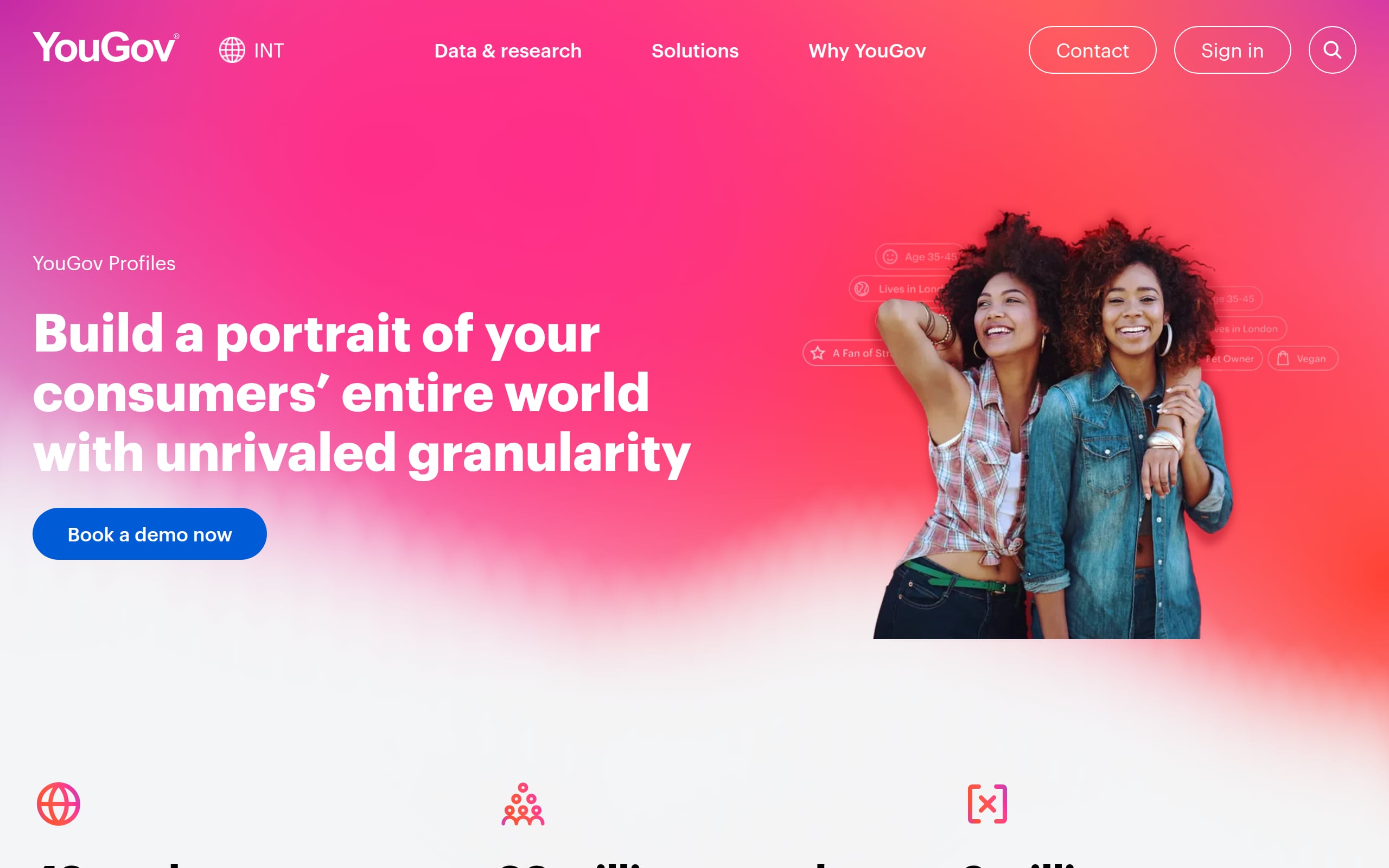
YouGov Profiles turns one of the world’s largest opt‑in panels into a practical engine for audience discovery, sizing, and activation. It’s built for fast, defensible segmentation that goes beyond demographics.
Data sources & trust: 30M+ opted‑in panelists across 49 markets, refreshed weekly and linked to BrandIndex/Global Profiles and survey tools, supported by transparent methodology, quality controls, ISO certifications, and GDPR/CCPA‑aligned compliance.
Capabilities that move the needle:
Build hyper‑specific segments across thousands of demographic, psychographic, media, and brand attributes.
Surface differentiators automatically with z‑scores; compare audiences across markets and time.
Re‑contact segments for bespoke studies; analyze in Crunch; export to Excel/PowerPoint.
Find audiences with natural‑language search that converts descriptions into matching segments.
Activate modeled audiences to DV360, Meta, The Trade Desk, and more in roughly two weeks.
Govern at enterprise scale with seat controls, ISO 27001, and privacy alignment.
Who it’s for & where it shines: Agencies, consultancies, media planners, brand/growth teams, and product marketers who need fast audience intelligence they can activate. Minutes to scope with Profiles Lite, hours to compare segments, and about two weeks to deploy media, ideal for persona validation, GTM planning, and pitch‑ready insights.
Pricing snapshot: Enterprise subscriptions with custom pricing; Profiles Lite offers free scoping; activation/Global Profiles may require add‑ons.
3. Statista

Statista is the one‑stop shop for secondary market evidence, with charts and surveys you can drop straight into decks when stakeholders demand quick proof.
Data sources & trust: Aggregates vetted statistics from 22,500+ public/private sources and runs proprietary surveys. Consumer Insights offers syndicated, survey‑based data in 50+ countries and 15,000+ brands, complete with downloadable methodology, multi‑stage quality review, and GDPR‑aligned governance.
Capabilities that move the needle:
Size and compare audiences using demographic, psychographic, and behavioral filters with cross‑tabs and projections.
Benchmark brands via syndicated KPIs to inform positioning and messaging.
Build analyses from transparent Consumer Insights questionnaires and fieldwork notes.
Track channel sentiment and trends with recurring Pulse and Media modules.
Export presentation‑ready charts to PowerPoint, PDF, PNG, XLS, or CSV.
Integrate via Statista Connect API; enable SSO, permissions, and audit controls.
Who it’s for & where it shines: Agencies/consultancies, in‑house marketers, product/UX teams, and founders needing credible, presentation‑ready stats fast. Perfect for persona sizing, brand tracking, media planning, and pitch‑ready market overviews that accelerate alignment and de‑risk decisions.
Pricing snapshot: As of December 2025, Starter $199/month, Personal $599/month, Professional (5 seats) $1,299/month; Consumer Insights $1,055/month; enterprise custom, annual contracts.
4. Mosaic by Experian

Mosaic is Experian’s household‑level lifestyle segmentation, your shortcut to shared language about audiences that works across analytics, planning, and activation.
Data sources & trust: 19 Groups/71 Types built from ~300 attributes (public records, census/geo, property, surveys, and proprietary/transactional sources). Accuracy benchmarked by Truthset; privacy controls and data separation documented by Experian.
Capabilities that move the needle:
Append Mosaic Groups/Types to CRM via secure matching on address, email, or mobile.
Profile customers in the portal; compare audiences, surface skews, and map geographic hotspots.
Tap Mosaic Verticals to access 800+ lifestyle and 300–500 industry attributes per segment.
Size and activate audiences across CTV, social, and programmatic via LiveRamp, Quantcast, Samsung Ads.
Operate in cookieless contexts by pairing Mosaic with contextual/location partners; export CSVs for BI/CRM.
Who it’s for & where it shines: Agencies, in‑house marketers, and analytics teams needing fast, defensible audiences without new surveys. Days to a few weeks to operationalize, ideal for persona creation and TAM sizing, GTM/media planning, pitch‑ready segment narratives, and privacy‑resilient activation.
Pricing snapshot: Enterprise licensing is custom, typically annual for portal plus data; activation incurs additional fees; regulated uses are excluded.
Advertising & Brand Measurement
Once campaigns are live, this set reveals what moved, such as awareness, consideration, favorability, and incremental outcomes. They’re grouped for methodologies that compare exposed versus control audiences and link media delivery to brand and business lift across channels. Use them to optimize in-flight, prove ROI, and inform the next creative brief.
1. Upwave (Formerly Survata)

Upwave quantifies brand outcomes and validates on‑target reach across CTV, linear, digital, social, and retail media, so marketers can optimize spend with causal clarity, not guesswork.
Data sources & trust: Deterministic ad‑exposure tags/integrations combined with short publisher‑intercept surveys; control matching and causal inference; triple fraud/attention/veracity filtering; micro‑cohort privacy and CCPA posture.
Capabilities that move the needle:
Measure causal lift for awareness, consideration, and purchase intent with tactic‑level cuts.
Verify on‑target reach, frequency, and penetration by channel/partner/program/segment.
Spin up 90‑second questionnaires quickly; publisher intercepts reduce bias and improve quality.
Optimize mid‑flight using Outperformance Indicator and Persuadability Scores.
Export AI‑generated, pitch‑ready decks and takeaways; share workspaces and alerts.
Unify cross‑media exposure via manager and integrations (CM360, GAM, TTD, Amazon DSP) with privacy safeguards.
Who it’s for & where it shines: Brand and media teams, agencies/consultancies, and media owners investing heavily in CTV and digital. Expect same‑day setup and first reads within a week, ideal for always‑on brand lift, on‑target reach validation, creative/channel optimization, and executive‑grade reporting.
Pricing snapshot: Custom, quote‑based enterprise pricing; available via The Trade Desk’s Measurement Marketplace; SaaS/usage model with no public rates or trials.
2. NielsenIQ

NIQ (formerly NielsenIQ) anchors brand decisions to sales reality, connecting brand health and consumer behavior to measurable retail outcomes. If your board asks “will it move share?” this is the dataset they expect to see.
Data sources & trust: Retail Measurement Services POS data, Homescan/Omnishopper panels, and survey programs unified in Discover/Connect, plus published methodology docs, quality controls, GDPR/CCPA notices (GPC), and media‑measurement certifications.
Capabilities that move the needle:
Quantify channel/creative ROI with MMM calibrated by store‑level RMS and panel data.
Monitor share, price, and promo lift via The Full View, including e‑commerce and club channels.
Track brand health with Brand Architect surveys linked directly to sales drivers.
Design trackers with advanced logic/quotas; accelerate builds via Verint and route to Discover/Connect.
Size segments from Homescan/Omnishopper; analyze trial, repeat, switching, loyalty, and media exposure.
Export pitch‑ready stories and weekly UPC/account extracts; integrate with BI/CRM under SSO governance.
Who it’s for & where it shines: Brand and growth leaders at CPGs/retailers, retail‑media and creative agencies, and data‑driven founders. Prebuilt market reads speed time‑to‑value, perfect for persona creation, MMM‑guided budget shifts, retailer pitch decks, and competitive tracking that produce defensible, share‑moving plans.
Pricing snapshot: Custom enterprise subscriptions/SOWs; Byzzer offers a free tier and partner bundles from roughly $1K, with coverage‑dependent categories and seat limits.
3. Resonate

Resonate fuses survey‑grounded psychographics with massive behavioral signals to reveal motivations, intent, and impact, and then lets you activate those audiences.
Data sources & trust: Resonate Elements spans 15,000+ attributes across 250M U.S. profiles from double‑opt‑in surveys, 30B+ online behaviors, and a multi‑ID graph; rAI models in Ignite; U.S.‑only operations with a public Trust Center.
Capabilities that move the needle:
Build personas and micro‑segments across 15K+ psychographic, intent, media, and demographic attributes.
Create audiences with rAI natural‑language Audience Builder for rapid discovery.
Size/compare audiences across 250M profiles and a 1B+ identity graph.
Enrich first‑party CRM/site data to expose motivations, early intent, and churn risk.
Track sentiment and category trends via bi‑monthly studies and weekly‑refreshed segments.
Activate to major DSPs; export reports; integrate with BI/CRM under privacy controls.
Who it’s for & where it shines: Agencies, in‑house marketers, and insights/product teams needing fast, activatable audience intelligence. Use it for persona creation and creative briefs, GTM planning and conquesting, churn prevention, and rapid measurement loops that boost media efficiency and defensibility.
Pricing snapshot: Custom, typically annual contracts for Ignite, enrichment, and services; DSP data segments billed per platform; no public list pricing.
Implementation best practices
Start small and build habits that scale.
Define a single research home
Make one workspace the home for briefs, results, decks, and personas. Market research software becomes more valuable when past work is easy to find.Standardize templates
Use consistent survey blocks, interview guides, and persona fields. Start with our persona templates for different industries to speed analysis and comparison.Label evidence
Tag insights as First Party, Data Backed, or AI Inferred so reviewers know what to trust and what to test.Close the loop with activation
Hand off personas and messages to sales enablement and media with the same IDs used in research.Train and govern
Keep a short guide on sampling rules, consent, and privacy controls.
Fact 16) Clear consent processes are a requirement under modern privacy regulationsMeasure adoption
Track which teams use which artifacts and refresh the most used ones first.
Teams that need presentation ready personas quickly can start with MixBright and refine in app.
Conclusion: choose confidently and iterate
The right market research software compresses the path from question to confident decision. Pick tools that make evidence visible, turn insights into human stories, and export cleanly into the decks your stakeholders expect. Keep the workflow light, automate where you can, and keep personas relevant by refreshing segments on a predictable cadence. If you want a guided path from brand input to audience insight and persona, try a demo at MixBright.
FAQ
What is market research software and how is it different from analytics tools
Market research software is built to design studies, gather data, analyze findings, and tell the story. Web and product analytics measure behavior that already happened. Many teams use both.
How quickly can a team get value
With a clear brief and access to data, many teams can produce a defensible persona or concept readout in a few days. Platforms that export directly to slides remove a major bottleneck.
Does market research software handle both qualitative and quantitative work
Yes. Many suites combine surveys, interview tooling, and text analytics. For advanced trade off work, look for conjoint or MaxDiff modules.
How do privacy rules affect research
You must collect consent and store data responsibly. Tools that align with GDPR, CCPA, and PIPEDA reduce legal risk and procurement delays.
What should a small team prioritize when buying
Prioritize speed to usable output, evidence transparency, and export quality. A single tool that creates personas and a deck can replace several disconnected steps.
Can this help with B2B buyer personas
Yes. Market research software can combine firmographic filters, role‑based needs, and behavioral signals to build credible B2B buyer personas that sales and product will use. For a fast, defensible start, check out MixBright.
How does MixBright compare to generic persona templates
Templates are a blank canvas. MixBright starts with your URL or brief, adds audience evidence, labels the strength of each insight, and exports polished decks so teams align faster.